


Home

Resources
Blogs
Blog
Get insights on AI, productivity, and the future of work.


Thank you! Your submission has been received!
Oops! Something went wrong while submitting the form.

Digital Marketing
Dec 30, 2025
5 mins
Leaf Removal Cross-Platform Marketing Isn't Scattered. You Skip These Easy 9 Framework Steps
Ishani Mitra
Leaf removal is not a year-round service, and that’s exactly what makes marketing it difficult. Demand shows up suddenly, peaks fast, and disappears just as quickly. Many businesses rely on one channel, one tactic, or one short burst of promotion, then wonder why results feel inconsistent every season.
Cross-platform marketing changes how seasonal services like leaf removal perform. Instead of depending on a single touchpoint, it connects multiple channels into one coordinated system.
In this blog, we break down how cross-platform marketing works specifically for leaf removal businesses, which channels actually matter, and how to coordinate them so short seasonal demand turns into consistent, profitable work.
What Cross-Platform Marketing Means for Leaf Removal Businesses?
Leaf removal is a seasonal service, but customer attention is not seasonal in the same way.
Cross-platform marketing means coordinating multiple channels so they reinforce each other. A customer might first see your brand on social media, later search on Google, notice a reminder email, and finally book after seeing a local ad. No single channel creates the conversion on its own. The combined exposure does.
This approach is especially important for leaf removal because demand is short, competition is local, and services are often interchangeable in the customer’s mind. Cross-platform marketing helps your business feel familiar, reliable, and available before the homeowner actively starts comparing providers.
Each platform plays a different role, but all point toward the same outcome: timely bookings during a narrow seasonal window.
Be Easy to Recognize
Clarify your message so homeowners immediately understand what you offer and why you’re reliable.
Clarify My Brand Positioning


Core Channels Involved in Cross-Platform Leaf Removal Marketing
Cross-platform marketing works best for leaf removal businesses when each channel plays a clear role instead of repeating the same message everywhere.
Below are the core channels that matter and how each one contributes differently to demand generation:
Website and Landing Pages
The website functions as the central validation layer in cross-platform marketing. While many bookings happen over phone or text, most homeowners still look up a business before committing.
This channel exists to:
- Explain leaf removal services clearly and seasonally
- Confirm service areas, availability, and legitimacy
- Reduce hesitation by answering common questions upfront
All other channels ultimately point here, even when the final conversion happens elsewhere.
Turn Visits Into Bookings
Build a seasonal landing experience that makes leaf removal easy to understand and quick to book.
Improve My Website
Local Search and Business Listings
Local search channels capture homeowners who already intend to hire someone. These platforms handle demand that is immediate and intent-driven.
Their role in the mix is to:
- Surface the business when urgency peaks
- Reinforce credibility after exposure from other channels
- Anchor visibility to specific neighborhoods and service zones
For leaf removal, these channels often carry the highest conversion intent during short seasonal windows.
Paid Discovery and Local Advertising
Paid channels introduce controlled visibility during peak demand periods. Unlike organic platforms, they allow businesses to appear precisely when competition is highest.
These channels are primarily responsible for:
- Capturing urgency-driven searches during heavy leaf weeks
- Expanding reach beyond organic visibility limits
- Accelerating demand when timing matters more than scale
They work best as amplifiers, not replacements, for other channels.
Social Media Platforms
Social media plays a familiarity and proof-based role rather than a direct conversion role. Homeowners use these platforms to observe, not necessarily to book.
Within cross-platform marketing, social channels help:
- Establish the business as active and legitimate
- Show real-world results and completed work
- Maintain visibility between decision moments
They reduce skepticism and shorten the trust gap before contact happens.
Direct Communication Channels (Email and SMS)
Email and SMS handle reactivation and reminder-based demand. These channels are most effective with existing or past customers.
Their primary function is to:
- Signal the start of leaf season
- Fill schedule gaps during slower weeks
- Reinforce availability without relying on paid reach
They quietly support consistency and repeat work rather than discovery.
Retargeting and Reminder-Based Channels
Retargeting channels connect earlier interest to later action. They exist to prevent demand from disappearing during short but postponable decision cycles.
These channels help by:
- Keeping the business visible after first exposure
- Focusing spend only on already-interested audiences
They serve as the connective tissue across the entire system.
Offline Visibility Channels
Offline channels still play a supporting role, especially in neighborhood-driven services like leaf removal.
Their role is not conversion, but:
- Triggering online search and validation
- Reinforcing recognition from digital exposure
- Making activity visible within local communities
When aligned properly, offline signals push homeowners directly into digital decision paths.
Cross-platform leaf removal marketing succeeds when each channel supports a specific step in the decision process. Visibility builds first, trust follows, and conversion happens where it feels easiest for the homeowner.
A Practical Framework for Cross-Platform Leaf Removal Marketing
This framework of cross-platform marketing breaks down how successful leaf removal companies structure marketing so that platforms don’t operate in isolation:
Start With Clear Positioning and Offers Before You Scale Distribution
Before you publish ads, post on social media, or pay for listings, you need clarity in what you stand for and what you’re actually selling. Strong cross-platform strategies don’t start with platforms, they start with a message that people can understand in seconds.
Positioning should explain who you help, what problem you solve, and why your solution is reliable. This message must look and sound the same everywhere so customers recognize you easily when the leaves pile up and urgency hits.
How to build strong positioning and sellable offers:
- Create a simple one-line value statement that makes your service instantly clear instead of vague or generic.
- Promote no more than two or three core offers so customers don’t have to “figure out” your business.
- Clearly explain what each offer includes, so nobody wonders if bagging, hauling, or multiple visits are separate charges.
- Display a starting price or reasonable range to reduce hesitation and build immediate trust.
- Assign one primary call-to-action per offer (call, text photo for quote, book online) to keep decision-making simple.
When your core message and packages stay consistent everywhere, people recognize you quickly and feel more confident contacting you.
Build One High-Intent Landing Experience That All Channels Point To
Even if most homeowners eventually call or text, nearly all of them look you up first. That makes your website or landing page the central conversion layer in your marketing system. If it’s weak, confusing, or generic, every other platform performs worse.
Your leaf removal landing page should feel seasonal, focused, and built specifically to help someone make a quick decision.
What a strong leaf removal landing page should include:
- A straightforward headline that clearly states what you do and where you operate.
- A short explanation of how your service works, so customers know what to expect from booking to cleanup completion.
- Clear service options with what’s included in each plan instead of vague feature lists.
- Real job photos showing before-and-after results so people can see credibility instead of just reading claims.
- Trust and confidence elements like reviews, ratings, service area information, and years in business.
- Multiple easy contact methods such as click-to-call, quick forms, or photo-quote submission so nobody hesitates.
This page becomes the main place every channel sends customers, ads, Google listings, emails, and social posts, ensuring everyone lands in a place designed to convert.
Show Proof Where It Matters
Create content that shows real results and builds trust before homeowners start comparing options.
Plan My Content
Use Local Search as your Primary Demand Listing
Most urgent work starts with a search. Someone looks outside, sees their yard buried under leaves, and types “leaf removal near me.” That moment is where business is won or lost. Local SEO validates every other marketing channel.
Your Google Business Profile acts like your reputation checkpoint. Even if people find you through ads, yard signs, or social media, many still search your name before calling.
How to strengthen leaf removal visibility in local search:
- Ensure your primary and secondary categories support leaf cleanup and related seasonal services.
- Add specific service listings like leaf removal, fall cleanup, and yard debris hauling so Google understands your relevance.
- Upload real seasonal photos showing your crew, equipment, and completed jobs during the peak leaf period.
- Post timely updates related to seasonal changes such as “Heavy leaf week” or “Final cleanup window” messages.
- Actively encourage reviews that mention leaf removal, specific neighborhoods, and positive experiences so your listing gains stronger trust signals.
On your website, dedicate a focused page entirely to leaf removal and use natural, location-based wording so it matches how customers actually search.
Get Found During Peak Demand
Capture high-intent local searches when homeowners actively look for leaf removal near them.
Strengthen My Local SEO
Turn Social Media into Visible Proof
For local service businesses like leaf removal, social media works best as a validation tool. People visit your profile to check whether you’re active, real, and competent.
Instead of pushing aggressive promotional content, use social media to make results visible and easy to believe.
What effective leaf removal on social media actually looks like:
- Consistent before-and-after transformations tied to recognizable neighborhoods so locals relate instantly.
- Short explanations of what each cleanup included and roughly how long it took to build credibility and trust.
- Helpful posts explaining when to book, seasonal timing expectations, or why waiting too long costs more.
- A steady posting rhythm during peak months so your business feels active instead of seasonal or unreliable.
Every post should quietly answer the questions customers are already thinking instead of trying to impress them with creativity.
Use Paid Media Strategically to Accelerate What Already Converts
Paid advertising works best when it amplifies offers and messaging that already perform well organically. It should never try to “fix” weak messaging or compensate for a poor website.
Search ads capture homeowners who already decided to hire someone and need help immediately. Social ads help you stay visible while people are still thinking, planning, or watching leaves build up.
How to get real results from paid campaigns:
- Target specific service areas or ZIP codes where you can respond quickly instead of wasting budget broadly.
- Promote focused, easy-to-understand packages instead of overwhelming people with all your services at once.
- Send paid traffic to your optimized leaf removal landing page rather than a general homepage where focus gets lost.
- Run paid campaigns only during hours and weeks when your business can answer and schedule quickly.
Paid ads should work like a seasonal volume booster.
Connect Channels So Each One Reinforces the Others
Cross-platform marketing becomes powerful when repetition builds familiarity. When customers see the same messaging, visuals, and service names across every channel, your business begins to feel steady, established, and reliable.
People convert after seeing consistent signals multiple times from different touchpoints.
Ways to create meaningful channel alignment:
- Repeat the same packages, visuals, and naming structure everywhere instead of reinventing language per platform.
- Retarget website visitors with helpful reminders or final-chance seasonal offers so interest doesn’t fade.
- Re-engage past customers before peak leaf weeks begin so you lock in repeat business early.
This layered repetition reduces hesitation and speeds up decisions.
Don’t Overlook Offline Signals That Trigger Online Action
Leaf removal remains heavily neighborhood-driven. People book when they see work happening nearby or when they notice others taking care of their yards. Offline visibility quietly pushes people directly into online search, where your online presence must be ready to convert.
Well-designed truck branding, clean uniforms, and simple yard signs signal competence, stability, and ongoing activity in the community.
Practical offline marketing that supports digital success:
- Use trucks as mobile billboards with clear text, readable contact information, and a simple message like “Leaf Removal & Fall Cleanup.”
- Place yard signs after each approved cleanup to create neighborhood curiosity and instant credibility.
- Build partnerships with HOAs, landscaping companies that don’t offer leaf removal, or gutter service providers who can refer work.
- Make sure anyone who searches your business after seeing you offline finds a strong online presence instead of an empty profile.
Add One “Follow-Up Loop” So You Don’t Lose Warm Leads
Cross-platform marketing creates a lot of almost-leads. People see you, save you, and wait. Your job is to stay present throughout:
- Set up a lightweight follow-up for anyone who asks but doesn’t book:
- Day 1: quote + availability window
- Day 3: “route still open in your area”
- Day 7: “last cleanups before season ends”
- Keep it simple: one message, one action, one deadline.
Measure What Actually Produces Profitable Jobs
Marketing is about generating the right leads at sustainable costs. When the season ends, what matters most is understanding which platforms brought real revenue, which neighborhoods responded best, and which offers converted fastest.
Instead of tracking everything, track what actually matters.
What to measure to improve every future season:
- The channels that consistently brought leads you enjoyed working with and could serve efficiently.
- Neighborhoods or service zones with the highest conversion rates and strongest customer response.
- Service packages that closed fastest, produced better profit margins, or generated loyal repeat clients.
- Where repeat work came from so you can double down on customer lifetime value instead of only new acquisition.
With this insight, the next season becomes structured, predictable, and significantly more profitable.
Final Thoughts
Cross-platform marketing solves a coordination problem more than a visibility problem.
When channels are planned together, each one plays a defined role. For leaf removal businesses, cross-platform marketing is less about doing more and more about doing things in the right order.
When that order is clear, seasonal demand becomes something you can plan around instead of chase.
Ready to Plan for the Season
Build a coordinated marketing system that turns short-term demand into predictable seasonal work.
Book A Consultation

Digital Marketing
Dec 30, 2025
5 mins
Tired of One-Time Electrical Jobs? Electrician Email Marketing with 8 Strategies That Keep Customers Coming Back
Ishani Mitra
Most electricians don’t struggle because customers aren’t interested. They struggle because once the job is done, the relationship quietly fades. No follow-up. No reminder. No reason for the customer to think of you again until something goes wrong, and by then, they’re searching from scratch.
Email marketing changes that dynamic by creating a steady line of communication that keeps your business familiar, credible, and easy to return to.
In this blog, we break down how electricians can use email marketing strategically. From what to send and when, to automation, segmentation, and measurement, you’ll learn how email fits into a practical marketing system that supports real business growth.
What is Email Marketing for Electricians?
Email marketing for electricians is the structured use of email to stay connected with past customers, nurture potential clients, and convert interest into booked jobs.
Unlike one-time ads or passive website visits, email gives you a direct communication channel with people who already showed intent, trust, or curiosity at some point.
For electricians, email is about being present when customers aren’t actively searching for home services, guiding them when they don’t understand electrical risks, and reminding them when maintenance, upgrades, or safety checks are due.
Where Email Marketing Fits In The Electrician's Industry?
Email marketing sits alongside your other marketing channels as the engine that keeps conversations alive long after the first interaction. While SEO, ads, referrals, and offline marketing help bring people to you, email helps you stay relevant so they don’t forget you when they actually need service.
Supporting SEO, PPC, Referrals, And Offline Work
SEO and PPC drive discovery. Referrals drive trust. Offline branding drives familiarity. Email strengthens everything by nurturing those contacts:
- It follows up on leads SEO and ads helped you capture, instead of letting them go cold.
- It supports referrals by reinforcing credibility with helpful, value-driven communication.
- It keeps offline contacts warm by turning business cards and job records into ongoing relationships.
Make Every Channel Work Together
Align content, SEO, and visibility so email supports a system customers already trust.
Align My Marketing Channels
Staying Visible Between Service Needs
Electrical services are not daily purchases. People may go months or years without calling an electrician. Email keeps your brand top-of-mind during these long gaps:
- Gentle maintenance reminders keep you relevant without pushing.
- Educational content builds awareness of risks and upgrades people often ignore.
- Occasional updates ensure customers remember your name when a real problem happens.
Reducing Reliance On Paid Lead Platforms
Platforms like Angi, Thumbtack, HomeAdvisor, and shared lead services can be expensive and competitive. Email helps you build your own audience so you don’t depend on them forever:
- It turns one-time customers into repeat customers.
- It reduces the constant pressure to “buy leads” to fill your schedule.
- It increases lifetime value from every job you complete.
In short, email marketing strengthens marketing efforts and makes every lead you earn more valuable.
How Electricians Can Build a High-Impact Email Marketing System?
Email marketing works for electricians when it stops sounding like “marketing” and starts functioning like a dependable communication engine that educates, reminds, reassures, and converts. Customers want safety, reliability, quick help in emergencies, and clarity on costs, and an email system delivers exactly that.
Here’s how to build one:
1. Build The Right Lists For Residential And Commercial
You don’t talk to a homeowner the same way you talk to a property manager. Your email list should reflect that.
Start with clean, separate lists
- Create at least two main groups: Residential customers and Commercial/industrial contacts like facility managers, builders, and property managers.
- Collect email plus name, phone, zip code, and basic service type (repairs, installs, maintenance) so you can send relevant messages.
Use soft opt-ins for residential
- Add a simple checkbox on your booking form: “Email me updates, maintenance tips, and occasional offers.”
- After each job, ask if the customer wants reminders for inspections, safety checks, or annual maintenance, then add them to your list when they say yes.
Use targeted sourcing for commercial
- Build commercial lists from local business parks, office buildings, HOAs, and industrial parks, focusing on decision-makers like operations, facilities, or property managers.
- Keep a spreadsheet or CRM to tag contacts by building type and potential contract size so you know where to focus follow-ups.
2. Use Cold Email Only For High-Value Commercial Work
Cold email can work well when you go after fewer, bigger clients like office buildings, schools, or warehouses, not homeowners.
Protect your main domain
- Buy one or two alternate domains (for example, yourelectricalco.co or yourelectricalco.net) and send cold emails from those, not from your main website address.
- “Warm up” those domains with a tool that sends small volumes of generic emails for a couple of weeks, so you don’t end up in spam on day one.
Keep lists clean and targeted
- Use a verifier tool on any scraped or purchased list to remove risky addresses before sending.
- Only keep contacts that match your ideal profile, such as facilities managers in your region, so you’re not wasting sends on people who will never hire you.
Send short, honest sequences
- Write sequences of three to five short emails, each about one specific benefit such as fewer outages, faster response, or safety compliance.
- Stop the sequence automatically when someone replies or books a call, so they don’t keep receiving follow-up emails after they are already engaged.
3. Set Up Simple Automation For Existing Residential Customers
Once a homeowner trusts you, a good email system keeps that relationship alive without you having to remember every follow-up.
Create a “new customer” follow-up sequence
- Week 1: Send a thank-you email confirming what you did and how to contact you if issues arise.
- Week 2: Share one or two simple safety or energy tips related to their job, such as breaker panel safety or lighting efficiency.
- Week 3: Ask for a review with a direct link to Google or your main review platform.
- Week 4: Send a light check-in to confirm everything is working well and gently remind them about reviews if they haven’t left one yet.
Add yearly reminders for safety and maintenance
- Schedule annual emails for things like panel checks, surge protection reviews, or rental property inspections.
- Offer a small recurring discount or “existing customer priority booking” so clients feel rewarded for staying with you.
4. Write Emails People Actually Want To Open
Electricians stand out in the inbox by being clear, human, and helpful.
Focus on strong, simple subject lines
- Aim for lines that answer “Why should I care?” in one second, such as “Quick check on your breaker panel” or “Is your rental up to code this year?”.
- Avoid clickbait; if the subject mentions a benefit, make sure the email delivers it.
Keep messages short and scannable
- Use short paragraphs, clear headings, and bold key phrases so people can skim and still get the point.
- End with one clear next step such as “Reply to book a slot,” “Click here to schedule,” or “Call this number for emergencies.”
Lead with value, then mention services
- Start with something useful such as a safety checklist, a quick energy-saving tip, or a common issue you are seeing in your area.
- Then explain how you can help if they want you to handle it, instead of opening with a sales pitch.
Give Customers a Reason to Remember You
Create clear, helpful content that electricians can reuse in emails to stay top of mind between jobs.
Create My Content System
5. Re-Activate Old Contacts And Missed Opportunities
A lot of work hides inside “quiet” contacts who liked you once but haven’t booked again.
Segment your inactive list
- Identify customers who have not opened emails or booked any job in six to twelve months.
- Exclude obviously cold contacts, such as bounced emails or people who asked to stop receiving messages.
Send simple “are you still okay?” campaigns
- Use short reactivation emails like “Do you still need help with electrical work at [street or area]?” with a clear “Yes, I might” button.
- Offer a light re-engagement incentive such as a safety inspection or small discount for bookings made within a short timeframe.
Clean your list regularly
- Remove contacts that never open or respond after several attempts, so your open rate improves and spam risks stay low.
- Keep your list focused on people who genuinely know your brand or could realistically hire you again.
6. Combine Email With Other Channels Instead Of Running It Alone
Email works best when customers see your brand in more than one place.
Sync email with ads and social
- Upload your email lists to platforms that support custom audiences, so your best contacts also see you in local social ads.
- Use the same message across email, ads, and your website, so the experience feels connected rather than random.
Tie the email into your CRM
- Store email engagement data in your CRM, such as opens, clicks, and replies, so you know who is warming up.
- Prioritize follow-up calls to people who open important messages or click on high-intent links like maintenance plans or quote requests.
Measure what actually drives work
- Track simple numbers: emails sent, opens, replies, booked jobs, and revenue from email-sourced work.
- Keep what brings actual jobs and quietly cut what only brings empty metrics like opens with no calls.
7. Respect Inbox Rules And Build Long-Term Trust
A healthy email system depends on trust with both your customers and email providers.
Stay compliant and transparent
- Always include a clear unsubscribe link and a postal address or legitimate business details in every email.
- Avoid sending marketing messages to people who never agreed to receive them, especially on the residential side.
Protect your sender reputation
- Keep bounce rates low by cleaning lists and using verifiers for cold outreach.
- Avoid spammy wording, excessive punctuation, and huge image-only emails that can trigger filters.
Think like a long-term partner
- Use email to build familiarity and peace of mind, not constant discount offers.
- Aim for customers who think, “These are my electricians,” not “These people email me nonstop.”
Done this way, email becomes a quiet but consistent engine, keeping you in front of the right people, at the right time, with the right message that turns into real booked work.
Best 8 Strategies for Email Marketing for Electricians
Here are eight practical strategies that go beyond the basics and actually help you book more paid jobs.
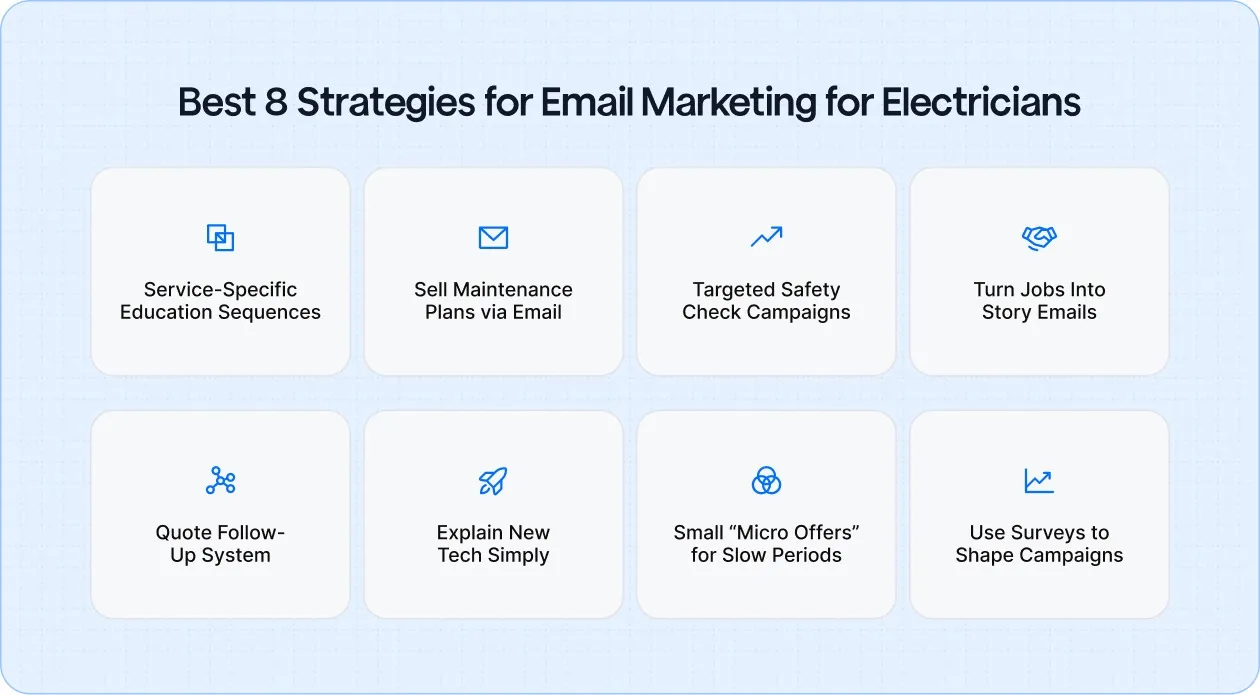
1. Build Service-Specific Education Sequences
Not every subscriber needs the same advice. A landlord, a new EV owner, and a restaurant manager care about different risks and upgrades.
How to set this up:
- Tag each contact by the main service they used or asked about, such as EV chargers, panel upgrades, lighting, or commercial work.
- Create short three to four email sequences per tag, focused on safety tips, common issues, and simple upgrade ideas for that specific service.
- Include one clear “If you want us to handle this for you” call to action in each email.
2. Use Email To Sell Maintenance Plans And Service Agreements
Email is perfect for explaining the value of maintenance plans without rushing the conversation on-site.
How to approach this:
- Send a simple “Here’s what a yearly check includes” email with bullets and plain pricing.
- Explain the benefits in customer language: fewer surprise outages, faster response, and clear records for insurance or compliance.
- Offer a small perk for plan members, such as priority booking or a discounted yearly plan for 2 to 3 services.
3. Run Targeted “Safety Check” Campaigns By Home Or Building Type
Electrical issues feel abstract until they match a real risk. Safety campaigns make those risks concrete without scaring people.
How to target these:
- Segment by rough home age or type if you collect that data, such as older homes, rentals, or small businesses.
- Send short campaigns about specific risks: overloaded panels, old wiring, or unprotected surge points.
- Offer a fixed price “safety visit” with clear scope, so it feels like a decision, not an open invoice.
4. Turn Finished Jobs Into Simple Story Emails
People remember stories better than features. Use past work to show what you do.
How to build story emails:
- Pick one job each month and write a short “Problem → Work done → Result” summary with one or two photos.
- Remove technical jargon. Focus on how it helped the customer: no more outages, quieter lighting, safer panel.
- Add a line like “If your setup looks similar, reply and we’ll take a look.”
5. Create A Quote Follow-Up System Based On Job Size
A small outlet repair and a full panel upgrade do not need the same follow-up rhythm.
How to structure this:
- Group open quotes by value bands, such as under $500, $500–$3,000, and above that.
- For small jobs, send one short reminder after a few days, then close the loop politely.
- For larger quotes, plan several touches, such as one check-in, one “questions you might have” email, and one final deadline reminder.
6. Use Email To Explain New Technologies In Plain Language
New products, such as smart panels or advanced surge protection, confuse many customers. The electrician who explains them simply often wins the work.
Ways to do this:
- Send occasional “plain English” explainers on one topic only, like EV charging, whole-home surge protection, or LED conversions.
- Answer basic questions: what it does, who needs it, what a typical job looks like, and rough price ranges.
- End with a soft “Want us to see if this fits your home or building?” invite.
7. Build Small “Micro Offers” For Slow Periods
Instead of blasting discounts at random, time small offers to help fill slower weeks without training customers to wait for deals.
How to use micro offers:
- Identify months or days when your schedule often has gaps.
- Email a limited, clear offer to a small segment, such as existing customers in a close radius or past repair clients.
- Keep offers simple, like a fixed price safety check or a small discount on one upgrade, and make the end date clear.
8. Use Surveys And Quick Polls To Shape Future Campaigns
Your list can tell you what to sell next, if you ask the right questions.
How to collect insight:
- Send one or two question polls a few times a year, such as “What worries you most about your electrical setup?".
- Ask which topics they want help with, like saving on bills, safety checks, or smart home service upgrades.
- Use the answers to design your next campaigns, offers, and education sequences so they match real demand.
Final Thoughts
Email marketing doesn’t replace good service, referrals, or local visibility. It supports them. For electricians, its real value shows up over time. In fewer dropped leads. In customers who come back without being reminded. In jobs that get approved faster because trust has already been built.
The difference between email that gets ignored and email that works comes down to intent and structure. When emails are written with purpose, timed around real customer behavior, and measured against actual outcomes, they stop feeling like marketing and start feeling like part of how the business runs.
Ready to Build Repeat Business
Get a practical marketing system that supports steady work without relying only on ads or lead platforms.
Book A Consultation

Digital Marketing
Dec 26, 2025
5 mins
Air Duct Cleaning Marketing Made Simple in 2026 using Mobile First Strategies
Ishani Mitra
Air duct cleaning is a business where attention is fragmented. Homeowners hear about it from HVAC techs, property managers, inspectors, online ads, and the occasional social post, often out of order and without context.
As a result, many air duct cleaning companies struggle not because people don’t need the service, but because their marketing doesn’t clearly connect the dots.
Good marketing in this space is about building steady visibility, explaining value in simple terms, and staying present across the places customers already spend time, especially on mobile.
In this blog, we break down how marketing for air duct cleaning businesses actually works today, which strategies matter most, how mobile marketing fits into the bigger picture.
What Is Marketing for Air Duct Cleaning Businesses?
Marketing for air duct cleaning businesses is the system that makes sure homeowners know you exist, understand what you do, and trust you enough to call when the need arises. Unlike emergency plumbing or HVAC repairs, duct cleaning is often preventative. That means customers rarely search with urgency unless they’ve already been educated or reminded of the problem.
Effective marketing bridges that gap. It builds awareness before demand peaks, reinforces credibility through proof and explanation, and ensures your business stays visible in local markets where decisions are made quickly and comparisons are shallow.
At its core, air duct cleaning marketing focuses on three things:
- Being discoverable when homeowners start researching indoor air quality, allergies, or home maintenance
- Explaining a service that most people don’t fully understand
- Staying present long enough for awareness to turn into action
This is why duct cleaning marketing works best when multiple channels support each other rather than operating in isolation.
How Mobile Marketing Strengthens Air Duct Cleaning Marketing?
Most searches, reviews, and comparisons happen on phones, often in short windows of attention. Mobile marketing strengthens air duct cleaning marketing by aligning with how homeowners actually discover, evaluate, and choose service providers today.
Mobile-first behavior shows up across the entire journey:
- Homeowners search on mobile when they notice dust, odors, or allergy symptoms
- They scan reviews, photos, and service descriptions quickly
- They prefer tap-to-call, short forms, and fast-loading pages
Mobile marketing supports this behavior by making every touchpoint easier to act on.
Key ways mobile marketing reinforces duct cleaning marketing:
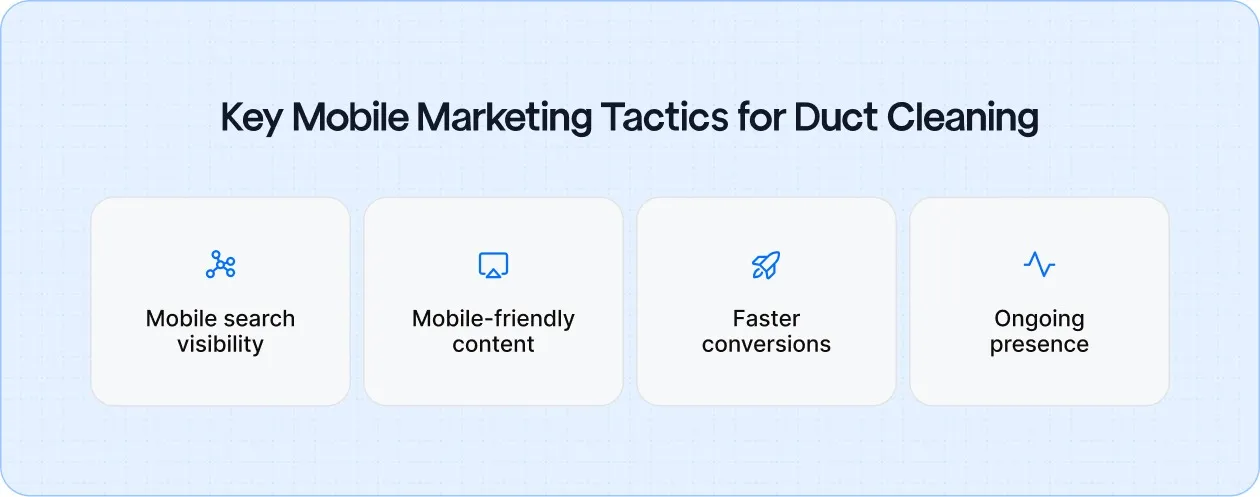
- Mobile search visibility: Local SEO, Google Business Profile listings, and Local Service Ads surface your business where mobile users look first
- Mobile-friendly content: Short videos, visual explanations, and simple comparisons help explain duct cleaning without overwhelming the viewer
- Faster conversions: Click-to-call buttons, mobile-optimized landing pages, and SMS follow-ups reduce friction between interest and booking
- Ongoing presence: Mobile ads, social feeds, and remarketing keep your business visible even when homeowners aren’t ready to book immediately
When marketing for air duct cleaning is designed with mobile behavior in mind, it becomes easier for homeowners to understand the service, trust the provider, and take the next step without hesitation.
How Can Air Duct Cleaning Businesses Effectively Market Their Value?
The strategies below reflect how successful duct cleaning companies build demand across different stages of awareness and intent.
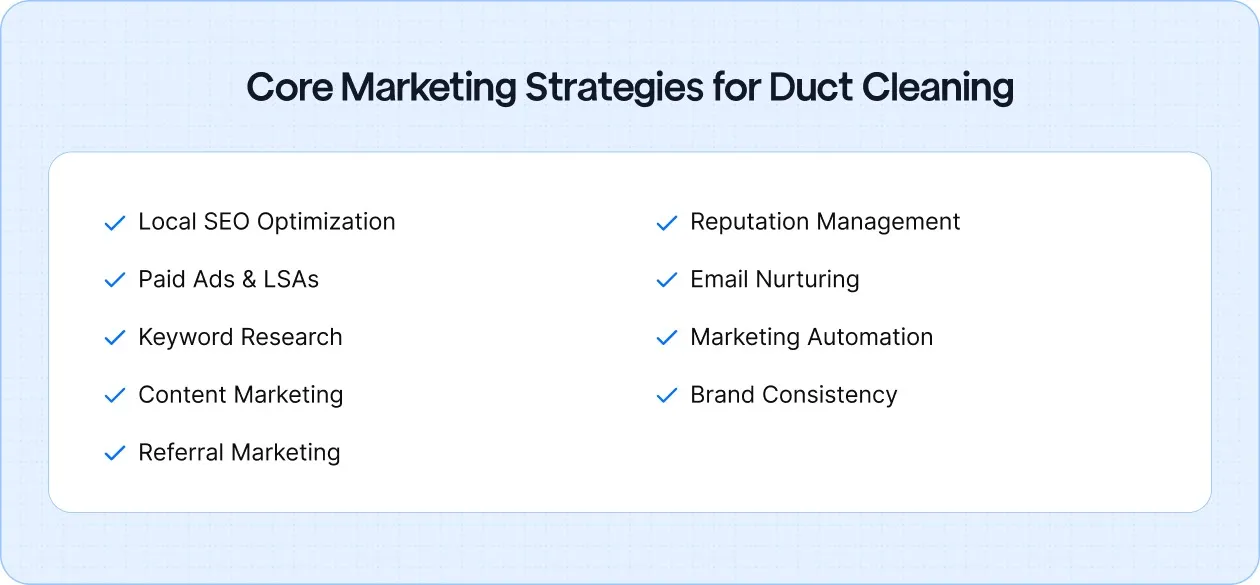
Core Marketing Strategies For Air Duct Cleaning Businesses
These strategies form the foundation of marketing for air duct cleaning businesses, regardless of device or platform. They focus on visibility, trust, and steady lead generation over time.
Local SEO And Google Business Profile Optimization
Local SEO determines whether your business is the first name people see when they search “air duct cleaning near me” or whether you get buried under competitors. Your map ranking, reviews, and Google profile often decide whether you get a call.
To make local SEO actually work:
- Fully optimize Google Business Profile with accurate services, real service areas, and correct categories so Google clearly understands what you do and where you operate, improving visibility in map packs and local searches.
- Upload real photos of equipment, team, and jobs, because homeowners trust real proof over stock images and Google rewards active, updated profiles with higher visibility.
- Collect reviews consistently and respond professionally, since reviews directly influence ranking, conversions, and trust. A steady flow of recent positive reviews beats old 5-star ratings every time.
- Use location-based keywords naturally on your website, service pages, and blogs so your content signals relevance for your city rather than competing nationwide for impossible terms.
A strong local SEO foundation means you rely less on ads, build credibility naturally, and create a pipeline of predictable leads.
Get Found at the Right Moment
Show up in local searches when homeowners start looking for air duct cleaning near them.
Strengthen My Local SEO
Paid Search And Local Service Ads (LSAs)
Paid ads help you capture the most motivated customers, the ones already searching and ready to book. For duct cleaning, these ads work especially well during allergy seasons, after renovations, or when HVAC demand spikes.
How to use paid ads effectively:
- Target high-intent keywords and problem-based searches, so ads appear when someone needs help now, not when they’re browsing casually. This improves both conversion rates and cost-efficiency.
- Use Local Services Ads to build trust instantly, because Google’s Guarantee badge reassures hesitant homeowners, making them more likely to contact you instead of a cheaper competitor.
- Focus on cost per lead and lead quality, instead of obsessing over impressions or clicks. If ads don’t convert into booked jobs, the channel needs optimization, not more budget.
- Ensure fast and professional call handling, since paid leads disappear quickly if nobody answers. Fast response time often matters a lot.
Paid ads become powerful only when your reputation, site, and communication are strong enough to back them.
Strategic Keyword Research
Keyword research ensures you’re targeting terms that actually bring revenue. For local service businesses like duct cleaning, the right keywords can mean the difference between qualified leads vs traffic that never books.
How to approach keyword research:
- Prioritize high-intent transactional terms, such as “HVAC duct cleaning,” “dryer vent cleaning,” or “commercial duct cleaning,” which signal buying intent rather than curiosity.
- Include problem-based and symptom keywords, like “dust coming from vents,” “musty smell from vents,” “allergies from AC,” because people search the problem before the service, capturing them earlier increases conversion likelihood.
- Build location-based keyword clusters, such as “air duct cleaning in [city],” and “[city] HVAC cleaning,” so you rank in multiple suburbs and towns, not just one primary area.
- Refresh keyword strategy every 6–12 months, since search behavior shifts with seasons, HVAC awareness trends, health awareness, and Google algorithm updates.
Strategic keyword planning gives direction to content, ads, local SEO, and website structure, instead of reacting to whatever comes your way.
Content Marketing And Education-Based Trust Building
Most homeowners don’t understand duct cleaning, when to do it, why it matters, or who to trust. Education removes fear and positions you as the expert.
Smart ways to use content:
- Create simple educational blogs and guides that explain warning signs, health benefits, and energy savings in plain language instead of technical jargon. This builds confidence and educates prospects before they call.
- Use FAQs to address anxiety and objections, especially around pricing, safety, timing, kids, pets, and allergies. When customers see their concerns answered, they hesitate less.
- Use visuals and short explanations instead of lengthy lectures, because customers want reassurance, not engineering lessons. Visual clarity earns trust faster.
Good content makes people more comfortable choosing you.
Explain the Service Simply
Create content that helps homeowners understand duct cleaning without confusion or technical overload.
Create Clear Educational Content
Referral And Partner Marketing
Some of the best duct cleaning leads come from people who already have strong homeowner relationships. These referrals convert faster, argue less on pricing, and trust you more.
Who makes great referral partners:
- HVAC companies that don’t offer duct cleaning, because they already get service calls and can easily recommend you, rather than sending customers away.
- Property managers and maintenance firms, who manage multiple units and need a reliable, repeatable partner rather than switching providers each time.
- Realtors, restoration companies, cleaners, and renovation contractors, who constantly deal with dust, odors, and post-construction clean environments.
Partner marketing is about creating dependable relationships so your business stays “the recommended choice.”
Consistent Reputation Management
In home services, reviews are currency. Most homeowners check Google reviews before even clicking your site, and volume + recency matter more than a static old 5-star rating.
A real review strategy includes:
- Proactively asking for reviews after jobs, instead of hoping customers remember. Make it part of your closing workflow, not an afterthought.
- Responding to all reviews, positive or negative, with a professional tone. Google tracks responsiveness, and customers judge how you handle issues.
- Spreading reviews across platforms, not just Google, Facebook, Yelp, Trustpilot, and industry-specific directories strengthen overall credibility signals.
- Making reviews visible on your website, turning social proof into a real conversion asset.
A disciplined review engine becomes one of your strongest revenue drivers.
Email Marketing And Nurturing
Not everyone books duct cleaning immediately. Many people browse, compare, hesitate, or need internal approval at home. Email helps you stay present in their inbox without pressure.
How to use email effectively in duct cleaning:
- Use simple nurture sequences after someone requests a quote, visits your site, or downloads content. These emails should educate, reassure, and gently push toward booking.
- Send seasonal reminders, especially before peak allergy seasons, pre-winter HVAC prep, or post-construction cleaning periods, timing alone can convert undecided prospects.
- Use email to build trust, by sharing reviews, safety assurances, certifications, and transparent explanations.
- Keep email concise, helpful, and human, because people don’t want corporate-sounding newsletters; they want clarity and reassurance.
Marketing Automations
Air duct cleaning businesses lose leads because they miss calls, forget follow-ups, or move too slowly. Automation prevents human error from costing revenue.
Automation that actually helps:
- Missed-call text back, instantly messaging prospects when you can’t pick up, so you don’t lose urgent jobs to competitors.
- Auto-follow-up reminders for quotes, repeat cleaning cycles, and maintenance windows so you stay relevant and proactive.
- CRM workflows that track leads, tag sources, and show which channels convert best, helping you make smarter budget decisions.
- Integrated booking links, so prospects can schedule without back-and-forth communication delays.
Brand Consistency
Many duct cleaning businesses lose trust simply because they appear disorganized. Branding is about being recognizable, dependable, and professional everywhere someone encounters your name.
Real brand consistency looks like:
- Same tone, identity, and value message across ads, website, trucks, invoices, uniforms, and follow-ups so your business feels “established”.
- Clear service positioning, like health benefits, cleaner homes, energy efficiency.
- Reinforcing expertise visually, with certifications, equipment photos, real job proof, and team imagery rather than stock pictures.
A clean, consistent brand makes price conversations easier because perceived professionalism increases perceived value.
Be Easy to Trust
Position your business as professional, reliable, and worth calling before comparisons begin.
Clarify My Brand Positioning
Mobile Marketing Strategies For Air Duct Cleaning Businesses
Most customers discover, research, and contact duct cleaners from their phones. Mobile behavior is fast, emotional, and urgency-driven, and your marketing must keep up with that reality.
Mobile-Optimized Website Experience
If your website is slow, confusing, or hard to use on mobile, you don’t just lose a visitor, you lose a paying job. Homeowners won’t try later. They will simply call someone else.
Key mobile priorities:
- Fast-loading, distraction-free pages, so visitors can quickly understand who you are, what you do, and why they should trust you, without waiting or getting lost.
- Click-to-call buttons immediately visible, because most mobile users prefer calling instead of filling out long forms. If they need to scroll to find your number, you’re losing sales.
- Clear navigation with visible services and areas served, so users instantly confirm you cover their location and can handle the job they need.
- Short, one-step contact forms, because nobody wants to complete a mini-application just to request pricing.
Mobile convenience directly impacts conversion rates, more than design, fancy copy, or branding.
Fix the First Impression
Make your website fast, clear, and easy to act on for homeowners searching on mobile.
Improve My Website Experience
SMS Marketing For Follow-Ups And Reminders
Texting works brilliantly in duct cleaning because it feels personal, fast, and simple. When used thoughtfully, it improves communication and drives more closed jobs.
How to use SMS correctly:
- Send appointment confirmations and reminders, reducing no-shows and making customers feel taken care of without requiring phone calls.
- Follow up on quotes casually, reminding customers without sounding pushy. A friendly check-in message often wins jobs lost to procrastination.
- Use seasonal or maintenance reminders sparingly, adding value instead of annoyance. Good timing creates repeat business naturally.
- Always provide a clear opt-out, so communication remains respectful and builds trust instead of irritation.
SMS boosts conversions, but only when used to support communication.
Mobile-Friendly Paid Ads And Extensions
Mobile users behave differently than desktop users. They skim faster, decide faster, and prefer instant contact instead of browsing deeply.
To optimize mobile ads properly:
- Use call extensions and location extensions, because they reduce friction and encourage immediate action instead of long browsing journeys.
- Write urgency-driven ad copy, addressing real problems like odors, allergies, dust buildup, or HVAC inefficiency.
- Run ads only during hours you can answer, since missed calls burn budget and damage reputation. Availability matters more than visibility.
- Test mobile-specific landing pages, built for quick decisions rather than long reading.
Click-To-Text And Live Chat Support
Mobile ads shouldn’t feel like desktop ads squeezed onto a smaller screen. They require their own strategy.
Best mobile social practices:
- Share short, real visuals of jobs, like dust extractions, before-and-after results, or behind-the-scenes work. Real proof beats marketing talk.
- Explain what customers are seeing in simple captions, so people actually understand why duct cleaning matters and when they should call.
- Post consistently but not aggressively, staying present without becoming repetitive.
- Highlight customer stories, problem-solving moments, and team professionalism, because people buy from businesses they trust.
Social authority strengthens brand memory so you’re the name they remember.
Missed-Call Text Back System
In home services, someone who calls a duct cleaner usually needs help now.
How to implement it effectively:
- Set up instant automatic texts like: “Sorry we missed your call! This is [Business Name]. Need duct cleaning help? Reply here and we’ll assist right away.”
- Use it during busy hours, after hours, and weekends, so you never truly “miss” a lead.
- Pair it with fast follow-up processes, so conversations turn into scheduled jobs.
This alone can recover thousands in revenue every year.
Measuring Your Air Duct Cleaning Marketing
Marketing only matters if it leads to real business outcomes. For air duct cleaning companies, success is less about big metrics and more about whether your efforts turn into calls, booked jobs, and repeat work.
A simple way to evaluate performance is to track how each channel contributes to customer action. This usually includes:
- Phone calls and form submissions from your website
- Leads coming from Google Business Profile, ads, or local listings
- Conversion rates from inquiries to booked services
Beyond lead volume, quality matters. Pay attention to:
- Cost per booked job, not just cost per lead
- Which campaigns bring homeowners ready to schedule, not just inquire
- Seasonal performance trends, especially before peak HVAC usage periods
Tools like Google Analytics, call tracking, and basic CRM reporting are often enough to identify what’s working and what needs adjustment. When marketing data is reviewed regularly, it becomes easier to double down on effective strategies and avoid spending time or budget on channels that don’t move the needle.
Conclusion
A well-structured marketing approach creates stability. It keeps your business visible between jobs, reinforces credibility before customers are ready to act, and makes it easier for people to choose you when the need arises.
Mobile marketing strengthens this system by meeting customers where they already spend their time and lowering friction at the moment of decision.
Over time, the businesses that win are the most consistent. Marketing becomes less about chasing leads and more about building a presence that customers recognize, trust, and return to when it matters most.
Ready to Build Steady Demand
Get a clear marketing plan that improves visibility, trust, and bookings over time.
Book A Consultation

Digital Marketing
Dec 26, 2025
5 mins
Marketing for Trailer Manufacturers Feels Unpredictable Until You Apply These 13 Channels
Ishani Mitra
Trailer manufacturers don’t struggle because demand is missing. They battle because growth is uneven. One quarter is strong, the next slows down. One dealer performs, another goes quiet. One product line moves fast, while others sit longer than expected. Over time, this unpredictability limits scale, planning, and investment.
Marketing is what brings structure to that chaos. Not by pushing promotions, but by creating consistent visibility, predictable demand signals, and clearer feedback from the market.
In this blog, we’ll break down how marketing for trailer manufacturers actually works today, which channels influence demand and sales, and what a modern marketing system looks like when growth is the goal.
Understanding the Trailer Manufacturing Market Before You Market It
Marketing works best when it reflects how the market actually functions. Trailer manufacturing is not a fast-turn, impulse-driven industry. In reality, the trailer industry is fragmented, relationship-driven, and shaped by purchasing behavior that doesn’t follow standard B2C or even typical B2B patterns.
Understanding these dynamics is critical before deciding how, where, or why to market:
Trailer Buyers Are Not a Single Audience
The trailer market includes multiple buyer types who evaluate products very differently. A landscaping contractor, a fleet operator, a dealer, and a municipal buyer may all purchase trailers, but they do not respond to the same messaging or marketing signals.
Key distinctions that affect marketing:
- Owner-operators often prioritize durability, financing, and immediate availability
- Fleet buyers focus on consistency, serviceability, and long-term cost
- Dealers care about margin, sell-through speed, and brand reliability
- Institutional buyers look for compliance, documentation, and vendor stability
Long Buying Cycles Shape How Demand Is Captured
Trailer purchases are rarely impulsive. Even when urgency exists, buyers often research weeks or months in advance, compare options repeatedly, and return to the same brands multiple times before making contact.
What this means for marketing:
- Visibility matters long before the buyer is ready to convert
- Repetition builds familiarity, which reduces perceived risk
- Education and clarity often matter more than persuasion
Dealers Influence Demand More Than Many Manufacturers Realize
For manufacturers with dealer networks, marketing doesn’t stop at lead generation. Dealers often become the face of the brand, influencing how products are presented, explained, and compared.
Market realities to account for:
- Inconsistent dealer messaging can weaken brand perception
- Manufacturers often compete indirectly with their own dealer listings
- Dealer success depends on how well marketing supports sell-through
Pricing Sensitivity Is Contextual
Trailer buyers are price-aware, but price is rarely the only factor. Perceived value is shaped by use case, risk tolerance, and downtime costs.
This affects marketing by:
- Shifting emphasis toward reliability, build quality, and application fit
- Reducing over-reliance on discounts as a primary hook
- Highlighting cost-of-ownership rather than upfront price
Geography and Regulation Quietly Shape Demand
Regional conditions play a larger role in trailer purchasing than many manufacturers account for. Climate, terrain, regulations, and local industry mix all influence what sells and how it’s evaluated.
Examples include:
- Different specs required across states or regions
- Regulatory compliance affecting purchasing timelines
- Regional industries driving demand for specific trailer types
Marketing that reflects these realities feels more relevant and credible to buyers.
13 Marketing Channels That Drive Growth for Trailer Manufacturers
Growth comes from combining multiple digital marketing channels that support long buying cycles, dealer networks, and product-specific decision-making.
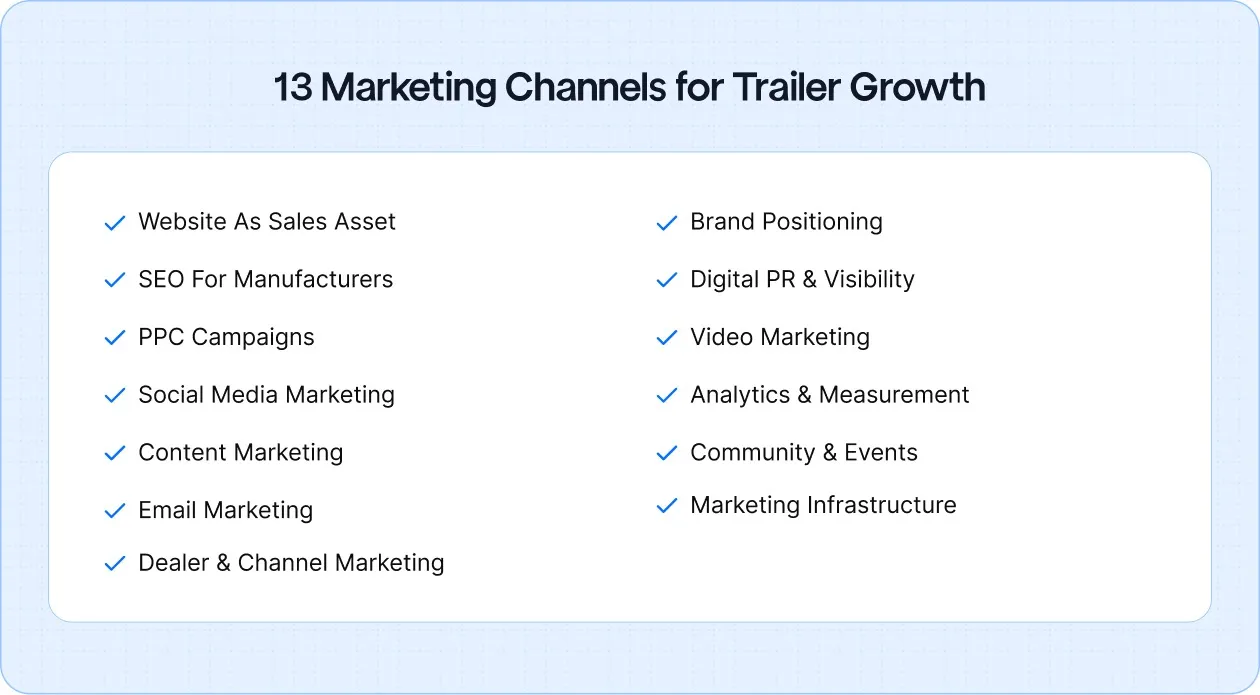
Each channel below plays a distinct role in how demand is generated, evaluated, and converted:
Website as a Sales and Positioning Asset
For trailer manufacturers, the website plays a far more active role than a catalog. It is often the first place buyers, dealers, and partners go to validate fit, understand use cases, and assess whether a manufacturer is credible enough to shortlist.
- Structure the site around how buyers evaluate trailers: Organize products by trailer type, industry application, and real-world use cases rather than internal product codes or model names.
- Translate technical specifications into practical outcomes: Specs matter, but only when buyers understand what they mean for durability, payload, compliance, or maintenance. Use plain explanations alongside technical details to avoid overwhelming non-technical decision-makers.
- Define the primary conversion path clearly: Decide whether the website’s main goal is dealer referral, direct inquiries, or a hybrid approach.
- Dealer locator flows for distributed sales networks
- Direct inquiry or quote requests for manufacturer-led sales
- Clear guidance so buyers know what happens after they submit a form
- Use the website to reinforce positioning: Messaging should make it clear who the trailers are built for, what problems they solve best, and where the brand sits in the market.
Make Your Website Work Harder
Turn your site into a clear sales and dealer-support asset instead of a static product catalog.
Improve My Manufacturing Website
SEO for Trailer Manufacturers
SEO supports trailer manufacturers throughout long research and comparison cycles. Buyers rarely search once and convert.
- Build visibility for all searches: Buyers may search for your brand name, but many start with generic terms tied to trailer type, load capacity, or industry use.
- Create product and category pages: Pages should reflect how buyers search, not how products are named internally. Clear category structures help search engines and buyers understand your offering.
- Support dealer discovery through SEO architecture: Location-aware pages, internal links, and structured navigation help buyers find the right dealer without friction.
- Invest in technical SEO to support scale and complexity
- Crawlable product and category pages
- Clean, consistent URLs across models and variations
- Structured data for products, manufacturers, and locations to improve search clarity
- Use Google Business Profile: Maintain accurate profiles for headquarters, plants, and dealer locations to capture local intent searches. Align GBP categories, services, and descriptions with how buyers search for trailer types and use cases.
Show Up Earlier in the Buying Cycle
Capture research-stage demand from buyers comparing trailer types and manufacturers.
Strengthen My Manufacturing SEO
Paid Advertising and PPC Campaigns
Paid advertising allows trailer manufacturers to capture demand when buyers are actively comparing options. It works best when used selectively and strategically.
- Use search ads for high-intent queries: Focus on terms tied to specific trailer types, applications, or buying scenarios where intent is clear.
- Segment campaigns to maintain relevance: Separate campaigns by trailer category, buyer type, or industry use case to avoid generic messaging and wasted spend.
- Apply geo-targeting where dealer networks exist: Ads should support the dealer ecosystem by directing buyers to relevant regions or partners.
- Support long buying cycles with retargeting
- Re-engage visitors who viewed products but didn’t inquire
- Reinforce brand presence across search, display, and video during evaluation phases
Social Media Marketing for Trailer Brands
Social media supports trailer marketing by building familiarity and reinforcing credibility over time. It is not a direct sales engine, but it influences perception, recall, and trust in a visually driven industry.
- Share real builds and real-world applications: Content performs best when it shows finished units, in-use trailers, and practical scenarios. Application-focused content helps buyers visualize how it fits within their own operations.
- Maintain presence between buying cycles: Regular, grounded content keeps the brand recognizable when demand eventually arises.
- Choose platforms based on buyer behavior
- Visual platforms for showcasing products and builds
- Professional platforms for dealer relationships, partnerships, and B2B visibility
Content Marketing and Trailer Sales Content
Content marketing helps trailer manufacturers explain complexity before a sales conversation ever happens. It shortens evaluation timelines and improves the quality of inbound inquiries.
- Publish content that answers buyer questions early: Address common concerns around specifications, compliance, use cases, and comparisons.
- Use content to support both SEO and sales conversations: Sales teams and dealers should be able to reference content during follow-ups.
- Break down complexity without dumbing it down: Explain differences, trade-offs, and applications clearly so buyers feel informed, not sold to.
- Match content formats to buyer intent
- Blogs and guides for early research
- Comparison pages for mid-funnel evaluation
- Walkthroughs and demos for decision confidence
Educate Before You Sell
Create content that explains use cases, specs, and trade-offs before sales conversations begin.
Build Buyer-Focused Content
Email Marketing and Lead Nurturing
Email marketing supports decision-making by staying relevant during long, multi-stakeholder buying cycles.
- Support dealer and distributor follow-ups: Consistent, branded communication improves continuity across touchpoints.
- Reduce drop-off by delivering useful information: Emails should provide clarity and updates.
- Use email for practical, timely communication
- Product availability or lead times
- Financing or pricing updates
- New configurations, upgrades, or compliance changes
Dealer, Partner, and Channel Marketing
Trailer manufacturers grow faster when dealer and partner marketing is aligned, consistent, and easy to execute.
- Maintain brand consistency across third-party channels: Listings, descriptions, and visuals should reinforce the same everywhere.
- Support sell-through without undercutting partners: Marketing should strengthen dealer confidence, not compete with them.
- Enable partners through structured support
- Co-branded assets
- Centralized portals or asset libraries
- Clear guidelines on messaging and positioning
Brand Positioning and Market Differentiation
In trailer manufacturing, many products compete in crowded categories where buyers struggle to tell meaningful differences at a glance. Effective positioning helps buyers quickly understand what your trailers are designed for, why they exist, and whether they are the right fit for their application.
- Define the exact buyer and use case your trailers serve: Be explicit about industries, workloads, terrain, or usage patterns. Just as important, clarify scenarios where your trailers are not the right choice.
- Translate features into real-world advantages: Explain how design choices impact durability, safety, maintenance, or total cost of ownership. Focus on the differences buyers actually care about after purchase.
- Maintain consistent positioning across all channels: Website messaging, dealer materials, ads, and sales conversations should reinforce the same value narrative.
- Use positioning to simplify decisions: Strong positioning narrows choices for buyers instead of overwhelming them. Clear positioning helps prospects self-select faster and move confidently toward purchase.
Define What You’re Known For
Define exactly who your trailers are built for and why they win in real-world use.
Clarify My Brand Positioning
Digital PR and Industry Visibility
Digital PR extends credibility beyond your own marketing channels by placing your brand within trusted industry conversations. For trailer manufacturers, this matters because buyers often rely on third-party validation when evaluating long-term equipment investments.
- Earn visibility in industry-specific publications: Focus on trade media, transport publications, manufacturing outlets, and niche vertical platforms. Coverage should highlight expertise, innovation, or operational insight.
- Support SEO through earned authority: High-quality mentions and backlinks reinforce topical authority for competitive keywords. Industry relevance carries more weight than general media exposure.
- Use third-party validation to strengthen trust: Buyers place more confidence in brands referenced by respected external sources. This validation often influences dealer confidence as much as end buyers.
- Prioritize relevance over reach: A mention in a niche trade outlet often outperforms broad but generic exposure. Focus on where your actual buyers and partners pay attention.
Video Marketing and Product Visualization
Video helps reduce uncertainty by showing how products are built, how they perform, and how they are used in real conditions.
For manufacturers, video is as much a sales enablement tool as a marketing one.
- Use walkaround videos to explain configurations: Show options, variations, and use cases clearly. Address common buyer questions.
- Share factory and production footage: Highlight build quality, materials, welding, and quality checks. This reinforces manufacturing credibility and process control.
- Create reusable assets for dealers and sales teams: Videos should support dealer listings, sales calls, and follow-ups. Consistent visual assets improve message accuracy across channels.
Analytics, Tracking, and Performance Measurement
Marketing decisions in trailer manufacturing should be driven by evidence. Because sales cycles are long and involve multiple touchpoints, tracking must extend beyond surface-level metrics.
The goal is to understand which efforts contribute to real demand and revenue.
- Track performance across the full buyer journey: Measure how prospects move from awareness to inquiry to sale. Identify which channels influence early research versus final decisions.
- Connect marketing data with sales outcomes: Integrate CRM data to understand lead quality and conversion. This prevents over-investing in channels that generate volume but not revenue.
- Identify drop-off points in long sales cycles: Understand where prospects disengage and why. Use this insight to refine messaging, follow-up, or channel mix.
- Use insights to guide budget allocation: Shift spend toward channels that consistently support qualified demand. Reduce or refine efforts that do not influence actual sales.
Community, Events, and Offline-to-Online Marketing
Despite digital growth, trailer manufacturing remains relationship-driven. Trade shows, expos, and regional events still play a major role in visibility, trust, and partnership building.
The key is connecting offline exposure to ongoing digital engagement.
- Use events as brand visibility accelerators: Trade shows and dealer events introduce your brand to high-intent audiences. They support credibility in ways digital-only channels often cannot.
- Repurpose offline activity into digital content: Capture photos, videos, and conversations during events. Extend the impact through social media, email, and website content.
- Bridge offline interactions with digital follow-up: Ensure leads collected offline enter your digital funnel. Consistent follow-up reinforces professionalism and recall.
- Leverage local sponsorships strategically: Regional involvement strengthens presence in niche markets. These efforts support both brand recognition and dealer relationships.
Marketing Infrastructure and Technology
As trailer manufacturers grow, marketing complexity increases. Without proper systems, lead handling, dealer coordination, and reporting quickly become fragmented.
Infrastructure determines whether growth remains manageable.
- Use CRMs to centralize lead management
- Track inquiries across direct sales and dealer networks
- Maintain visibility into lead ownership and follow-up status
- Integrate inventory and marketing platforms
- Align available products with active marketing efforts
- Reduce friction between promotion and fulfillment
- Apply automation where it improves consistency
- Automate follow-ups, routing, and reporting where possible
- Avoid over-automation that removes human judgment from high-value interactions
- Maintain clear reporting and visibility
- Centralized dashboards help leadership evaluate performance
- Transparency prevents blind spots as volume scales
Common Challenges Trailer Manufacturers Face Without a Marketing System
When marketing is treated as optional or reactive, trailer manufacturers don’t usually notice the impact right away. The issues show up slowly, in missed opportunities, stalled growth, and increasing dependence on price to compete.
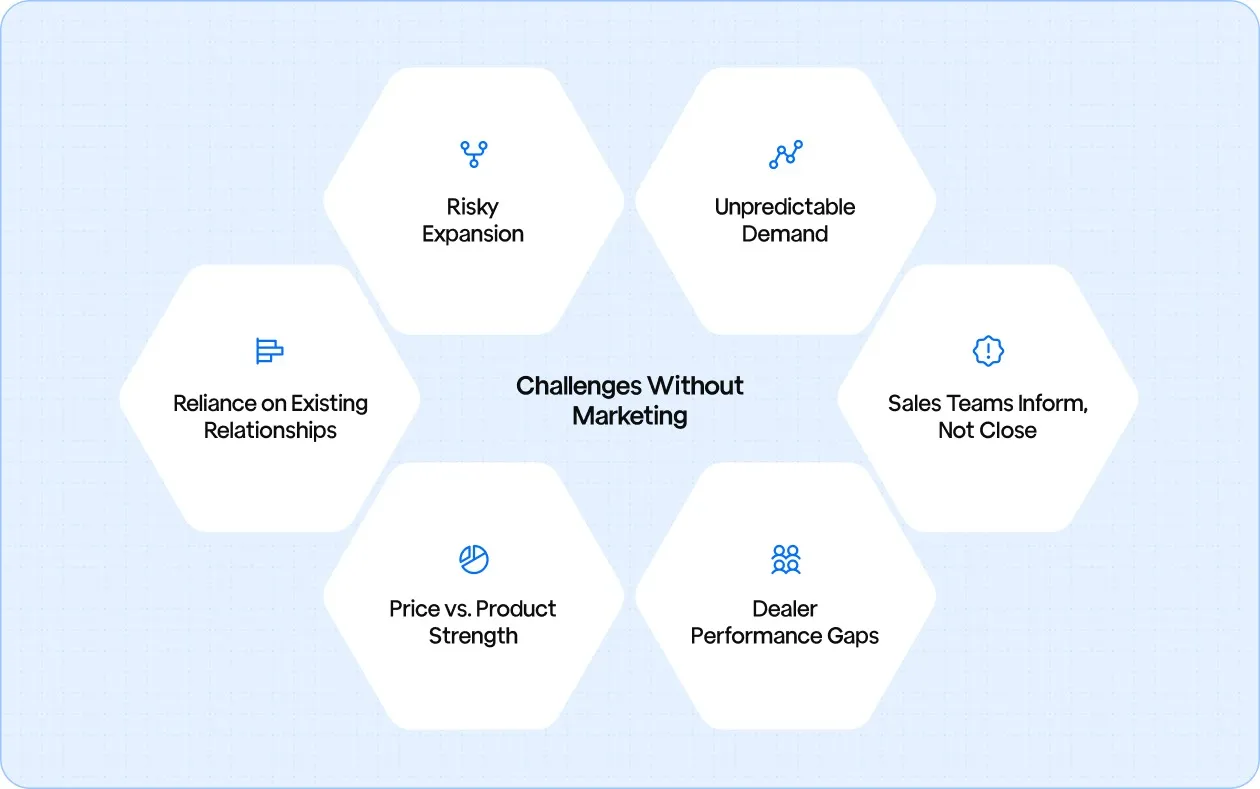
These marketing challenges stem from how the business is seen, understood, and remembered in the market:
Demand Becomes Unpredictable and Hard to Plan Around
Without marketing, demand tends to spike and stall without warning. This makes it difficult to:
- Plan production schedules confidently
- Forecast revenue beyond the short term
- Decide when to hire, expand, or invest
Marketing creates steadier demand signals. Without it, growth becomes reactive instead of intentional.
Sales Teams Spend Time Informing Instead of Closing
When marketing isn’t doing its job upfront, sales conversations start too early in the buyer’s understanding.
That usually means:
- Long calls explaining basic differences between trailer types
- Repeating the same explanations to every prospect
- Fewer conversations reaching serious buying intent
Marketing should handle early education so sales can focus on fit, pricing, and next steps.
Dealer and Partner Performance Varies Widely
In the absence of structured marketing, dealer success often depends on individual effort rather than system support.
This leads to:
- Inconsistent brand presentation across regions
- Some dealers outperforming while others stagnate
- Friction when manufacturers try to enforce standards later
Strong marketing creates alignment. Without it, performance gaps widen over time.
Product Strengths Get Lost in Price Comparisons
When buyers don’t clearly understand what makes one trailer different from another, price becomes the easiest comparison point.
This results in:
- Margin pressure during negotiations
- Difficulty justifying premium builds or options
- Customers choosing “good enough” alternatives
Marketing exists to frame value. Without it, differentiation collapses.
Growth Depends Too Heavily on Existing Relationships
Many trailer manufacturers rely on referrals, repeat buyers, or long-standing dealer ties. While valuable, this can quietly limit growth.
Over time, this creates:
- Exposure gets lost if a few large relationships slow down
- Difficulty entering new markets or regions
- Growth ceilings that aren’t obvious until they’re hit
Marketing reduces dependence on a small circle and opens new demand channels.
Expansion Feels Riskier Than It Should
Without clear market feedback from marketing channels, expansion decisions rely on instinct.
This makes it harder to:
- Validate new trailer types or configurations
- Enter new geographic markets confidently
- Test pricing or positioning changes safely
Marketing provides signals. Without those signals, expansion feels like guesswork.
Conclusion
The manufacturers that grow are not necessarily the ones with the biggest budgets. They are the ones that invest in clarity, consistency, and systems that support demand over time. Strong positioning, well-chosen channels, and aligned dealer marketing create momentum that compounds instead of resetting every quarter.
When marketing is treated as a business function, it stops being a cost center and starts becoming a growth lever. One that helps trailer manufacturers stand out, scale responsibly, and compete on more than just price.
Ready to Build Predictable Growth
Get a clear marketing system that supports dealers, sales teams, and long-term demand.
Book A Consultation

Digital Marketing
Dec 26, 2025
5 mins
Want More Sewer Line Jobs? Follow These 12 Social Media Marketing Strategies For 2026
Ishani Mitra
Sewer line work isn’t easy to explain online. The problems are underground, every job looks different, and once the repair is done, there’s often nothing visible to show for it. Because of that, many sewer line companies end up looking the same online, even when their skill level and experience are very different.
Social media changes that. It gives sewer line businesses a way to show how they diagnose problems, explain their decisions, and document the work that usually stays hidden. Instead of leaving homeowners to guess what makes one company better than another, social media lets you control the story.
In this blog, we’ll explore how sewer line service companies can use social media to clarify their expertise, communicate the value of their work, choose the right platforms, and build a presence that supports long-term growth.
What Is Social Media Marketing for Sewer Line Services?
Social media marketing for plumbers is the use of social media platforms to build visibility, credibility, and recognition for sewer line services. It focuses on showing real work, explaining common sewer line issues, and staying visible in local markets where most plumbing decisions happen.
Social media allows businesses to communicate consistently without relying only on emergencies or promotions. It helps plumbers stay present in a homeowner’s awareness so that when an issue arises, the business already feels familiar.
Social Media’s Transformative Potential For Sewer Line Businesses
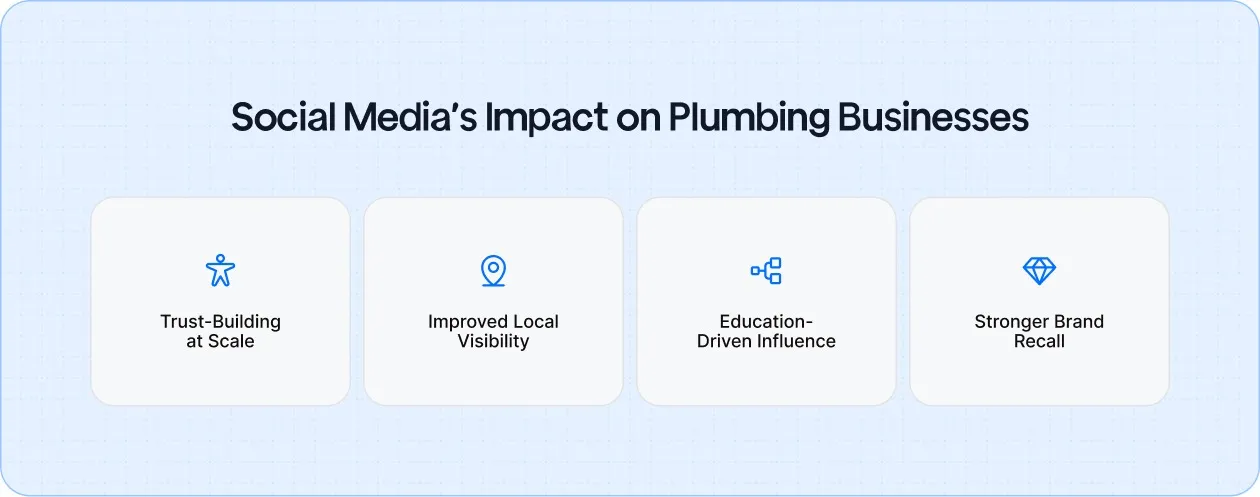
- Trust-building at scale: Sewer line is a service where credibility matters more than clever messaging. Sharing real jobs, clear explanations, and consistent updates helps reassure homeowners that your business is experienced and dependable.
- Improved local visibility: Social platforms naturally surface content to nearby users through location signals, community engagement, and local sharing. This keeps your plumbing business visible in the areas you serve without relying entirely on paid advertising.
- Education-driven influence: Simple explanations about leaks, clogs, water pressure problems, or preventive maintenance help homeowners understand issues before they turn urgent. This positions your business as knowledgeable and helpful rather than purely reactive.
- Stronger brand recall over time: Even when someone does not need a plumber immediately, regular exposure to useful and relevant content increases the chances they remember your business when a problem eventually arises.
Attract the Right Buyers
Most traffic fails because it targets the wrong decision-maker. Align your plan with real buyer intent.
Build an ICP-Driven Plan
Top Social Media Marketing Strategies for Sewer Line Businesses
The strategies below are designed to match how people actually use social media. They help you stay top-of-mind, build quiet trust over time, and make it easy for homeowners to remember you when they need a plumber fast:
1. Offer Simple DIY Tips to Establish Trust
Plumbing problems can be stressful, and homeowners often look for quick fixes. By providing easy-to-follow DIY tips, you can position your company as a trusted expert while offering immediate value to your audience.
- Create Bite-Sized Video Tutorials: Share short videos demonstrating simple fixes, such as how to stop a leaky faucet or how to unclog a drain. These videos should be easy to understand and provide actionable solutions.
- Highlight Common Mistakes: Educate your audience about common DIY mistakes. Post tips on what to avoid, ensuring followers understand when it’s better to call in a professional.
- Use Clear Visuals and Step-by-Step Instructions: Break down each tip with visual aids or diagrams. This makes it easier for your audience to follow and learn without feeling overwhelmed.
Providing free advice builds trust and encourages potential customers to come to you when they need professional help.
2. Show Off Your Transformations with Before-and-After Photos
One of the most impactful ways to demonstrate your expertise is by sharing before-and-after photos of your work. This type of visual content shows the immediate value you bring and makes it easier for potential customers to visualize the results.
- Highlight Dramatic Changes: Post high-quality photos that clearly show the transformation. Whether it’s replacing a rusted pipe or installing a new water heater, dramatic before-and-after images resonate with your audience.
- Use Captions to Explain the Problem and Solution: In each post, explain the challenge your team solved.
- Create Carousel Posts for Easy Comparison: Use Instagram or Facebook carousels to showcase a series of images showing the entire process. People love swiping through images, and this format works well for showing how much work goes into sewer line services.
These visuals build credibility and make your business feel reliable and efficient.
3. Educate Your Audience with Seasonal Sewer Line Checklists
Homeowners are often unsure about what tasks need attention during the different seasons. Creating seasonal maintenance checklists educates your followers and positions your business as a resourceful expert.
- Create Shareable Seasonal Guides: Develop seasonal content like “Winter Plumbing Checklist: Protect Your Pipes from Freezing” or “Spring Sewer Line Tips: Clean Your Drains and Check for Leaks.” These guides should be easy to read and packed with practical tips.
- Promote Checklists for Preventive Maintenance: Preventive maintenance is a great way to gain trust. Share checklists to help homeowners avoid costly repairs in the future. Highlight tasks such as drain cleaning, pipe insulation, and water heater inspections.
- Post Reminders with Countdown Timers: Use countdown timers or calendar reminders for tasks that need to be completed each season, like inspecting water heaters before winter or cleaning out gutters before the rainy season. This promotes timely engagement.
These posts engage your audience and drive repeat business by encouraging them to check off important tasks throughout the year.
4. Share Real Customer Testimonials and Success Stories
Word-of-mouth referrals are one of the most powerful ways to attract new clients. Sharing real customer testimonials on your social media gives your business social proof and builds credibility.
- Highlight Specific Success Stories: Share stories where your team went above and beyond to solve a customer’s unique problem. Use video testimonials or customer interviews to show authenticity.
- Create Graphics with Customer Quotes: Design simple posts featuring glowing customer quotes about your services. Add these testimonials to your social media feed or Instagram Stories for increased engagement.
- Engage with Reviews in Real-Time: When customers leave positive reviews on platforms like Google or Yelp, share them on social media in real-time. Always reply to reviews and thank customers for their feedback.
Positive testimonials build trust and provide an emotional connection, showing new customers that your sewer line company delivers on its promises.
5. Drive Immediate Action with Limited-Time Offers
Offering limited-time promotions creates urgency and encourages followers to take action. It’s a powerful tactic to turn social media engagement into conversions.
- Create Time-Sensitive Offers for Services: Run flash sales or seasonal promotions on services like drain cleaning, emergency repairs, or water heater installations. Make sure to include a clear deadline to incentivize people to act quickly.
- Offer Exclusive Discounts to Social Followers: Reward your loyal social media followers with exclusive discounts or a free service with the purchase of another. Encourage followers to share the post or tag a friend for additional savings.
- Promote Special Offers Through Stories and Ads: Use Instagram Stories to promote these offers with countdowns. Stories are effective for showcasing time-sensitive deals and can prompt quick decision-making.
These promotions can create a sense of urgency and drive immediate action from potential customers.
6. Keep Things Fun: Post Polls, Questions, or Memes
Adding some humor or light-hearted engagement helps humanize your brand and increases social interaction.
- Run Polls or Ask Fun Questions: Use platforms like Instagram Stories or Facebook Polls to ask fun or relatable questions such as, “What’s your least favorite sewer line problem?” or “Do you think a DIY fix will save you money?” These interactive posts help increase engagement.
- Share Plumbing Memes: Share funny, plumbing-related memes that your audience can relate to. Humor humanizes your business and makes your brand feel more approachable, especially when dealing with typically stressful topics like plumbing issues.
- Post Fun Facts or Industry Jokes: Post light-hearted fun facts about plumbing or share jokes about common frustrations.
Engaging with humor helps you build a fun brand personality that keeps your audience coming back.
7. Create “Emergency Sewer Line Tips” Content
Issues can happen at any time, and customers appreciate expert advice during emergencies. Sharing quick, actionable emergency tips shows you are a trusted resource when things go wrong.
- Explain Temporary Fixes Until Help Arrives: Offer temporary solutions like how to manage a leaking pipe using common household materials until your team can make it to the location.
- Create Engaging Video Content for Urgent Fixes: Post short, easy-to-follow video tutorials demonstrating how to handle common emergencies safely. This helps position your company as a quick solution provider in stressful situations.
This content demonstrates your expertise while providing immediate value to your audience.
8. Use “Did You Know?” Sewer Line Facts for Engagement
Fun and informative “Did You Know?” facts can spark curiosity and encourage engagement, helping you educate your audience while keeping them entertained.
- Share Interesting Industry Facts: Post fun facts like “Did you know that ancient Egyptians had some of the world’s first indoor plumbing?” or “The world’s most expensive faucet costs over $100,000!”
- Tie Facts to Your Services: Use interesting facts to promote your services. For example, “Did you know that water heaters should be flushed every year to prevent sediment buildup? We offer expert maintenance services.”
- Create Engaging Infographics: Visual facts or statistics work great on platforms like Instagram and Pinterest. Share educational infographics to encourage shares and engagement.
This type of content helps increase engagement while promoting brand awareness in a fun and educational way.
9. Share Behind-the-Scenes Content of Your Team at Work
Behind-the-scenes content is a great way to humanize your brand and give followers a deeper connection to your company. It’s also about the people behind the brand.
- Highlight Employee Achievements: Showcase your team’s expertise and experience by sharing stories about their background or recent achievements, such as completing specialized training or certifications.
- Celebrate Team Milestones: Share team anniversaries, new hires, or internal achievements, which helps followers feel a deeper connection to your business.
Behind-the-scenes content provides an authentic, relatable side to your sewer line company and creates a stronger bond with your audience.
10. Promote Referrals and Word-of-Mouth Marketing
Encourage your existing customers to spread the word about your plumbing services by rewarding them for referrals. Referral marketing is powerful and can grow your business through trusted customer recommendations.
- Create a Referral Program: Offer existing customers a discount or small reward for referring new clients. This turns satisfied clients into promoters of your brand.
- Share Referral Success Stories: Post about customers who have referred others and highlight their positive experiences. This builds social proof and shows that your customers trust your work enough to recommend you.
- Encourage Social Shares: Ask customers to share your posts or services on their own social media profiles. This can increase your visibility and attract new clients from their networks.
11. Utilize Paid Ads for Service Promotions
While organic reach is important, paid advertising on social media can help you target specific demographics and attract leads quickly. For plumbing companies, local ads are especially effective for reaching nearby homeowners and businesses.
- Run Targeted Facebook Ads: Use Facebook Ads to promote limited-time offers, service specials, or emergency plumbing services. Target by location, age, and interests to ensure you reach the right audience.
- Use Instagram Ads for Visual Promotions: Instagram Ads are perfect for showcasing your work, especially visually appealing services like bathroom or kitchen plumbing installations.
Paid ads are a fast way to increase visibility and drive local leads to your plumbing business.
12. Highlight Community Involvement
Plumbing companies can build a strong relationship with their local community by showcasing their involvement in local events or charity efforts.
- Support Local Causes: Share your involvement in charity events, sponsorships, or community improvement projects. Being seen as a local business that cares about its community will enhance your reputation.
- Post About Local Projects You’ve Helped: If you’ve worked on a community project or local initiative, highlight it on social media to build goodwill and attract local attention.
By showcasing your community involvement, you reinforce the idea that your plumbing business is not just about making a profit but also about making a positive impact on your community.
Best Practices for Effective Sewer Line Services Social Media Marketing
A social media strategy for sewer line companies should reflect how they actually operate. Jobs are unpredictable, demand is uneven, and most customers only pay attention when something breaks. A good strategy works around these realities instead of fighting them:
Set Clear Boundaries for What Social Media Should Handle
One of the most overlooked best practices is deciding what social media should not be responsible for. Social media should not replace referrals, local SEO, or service-based advertising, and it should not function as a daily promotion engine.
For sewer line businesses, social media reinforces professionalism and competence so that when customers search, compare, or hesitate, your business already feels established.
Ground Content in Real Service Scenarios
Social media content performs better when it reflects the reality of sewer line work. The strongest strategies start by identifying the most common service calls, recurring problems, and seasonal issues the business already handles.
Match Content to Different Decision Stages
Not every post should try to generate a call. A practical social media strategy includes content that serves different roles depending on where a homeowner is in their decision process.
Some posts build familiarity. Others clarify risks or explain problems. Some simply reinforce that the business is active and reliable. Planning content with this separation avoids repetition and keeps the feed useful without feeling scattered.
Show the Problem Before You Sell
Before-and-after footage, inspections, and real fixes build trust faster than promotions ever will on social platforms.
Plan High-Trust Content
Prioritize Clear Explanations Over Creative Messaging
In sewer line services, clarity outperforms creativity. Homeowners respond better to content that explains what’s happening, why it matters, and what typically comes next.
Posts that focus on plain language, accurate descriptions, and visual clarity tend to perform more consistently than clever hooks or trend-driven formats.
Use Location as a Quiet Trust Signal
Geography influences sewer line decisions more than most businesses realize. Effective social media strategies reinforce service areas naturally through references to neighborhoods, local conditions, soil types, or regional infrastructure issues.
This strengthens local relevance without needing to tag locations or repeat city names in every post.
Plan Content Around What the Business Can Sustain
Consistency matters more than frequency. A practical strategy matches posting expectations to real operational capacity.
Fewer posts, planned ahead and tied to actual work, outperform frequent posting that feels rushed or disconnected. Sustainable output keeps the brand visible without creating internal strain.
Separate Posting From Engagement and Response
Posting content and managing responses are different responsibilities. Strong strategies account for both.
Even limited engagement, when handled promptly and professionally, reinforces reliability. In service-based businesses, responsiveness often matters as much as the content itself.
Final Thoughts
Social media changes how sewer line service companies stay visible between jobs. Instead of relying only on ads, directories, or search results, it creates an ongoing presence that reflects how active, established, and invested a business is in its craft.
Over time, this presence compounds.
For sewer line service providers focused on long-term growth rather than short-term attention, social media offers a controlled, repeatable way to maintain relevance in an increasingly competitive landscape.
Turn Social Attention Into Service Calls
Social media works for sewer line services only when it mirrors how homeowners think under pressure and choose who to call.
Book A Consultation

SEO
Dec 24, 2025
5 mins
Landscape Lighting SEO: Strategies That Will Help Your Business Shine Bright in Search Results!
Batul Beawarwala
In the business of outdoor lighting, you know how important it is to create designs that leave a lasting impression, satisfy clients, and open doors for future opportunities. But great work doesn't mean much if no one can find you.
Landscape lighting SEO ensures your business shows up when local homeowners search for services like yours. From brightening gardens to enhancing security, SEO makes sure your business gets noticed when it matters most.
This guide will show you simple SEO strategies that put you in front of the right people at the right time.
Building the Foundation: Keyword Research for Landscape Lighting SEO
In SEO, not all keywords are equal. Instead of focusing on broad, generic terms, it's more effective to target long-tail keywords and location-specific phrases.
These keywords are more precise, with less competition, making it easier for your business to stand out in local searches.
Here’s what you should focus on:
- Long-Tail Keywords: These are specific phrases, such as “outdoor lighting installation in Dallas” or “garden lighting contractor in Boston.” These attract people who are actively looking for your services in your area.
- Location-Specific Keywords: These phrases help tell search engines and potential customers that you provide services in specific locations. For example, “landscape lighting in Chicago” or “garden lighting expert in Miami” will connect you with local clients.
By targeting these keywords, you’re ensuring your business shows up for exactly what people are looking for, at the moment they need it. This approach allows you to focus on terms that are more relevant to your community and avoid competing for overly broad keywords.
Structuring Content Around Keywords
Once you’ve identified the right keywords, the next step is organizing your website’s content in a way that’s easy for users to navigate and for search engines to understand. A well-structured website will help you rank better and keep your visitors engaged.
Here’s how to do it:
- Content Pillars: These are broad topics that cover key areas of your services. For example, a pillar page could be something like “outdoor lighting options” that introduces the different lighting solutions you offer.
- Topic Clusters: These are detailed pages that focus on specific aspects of your pillar topics. For example, “how to choose LED lights” or “benefits of solar-powered lighting”. Each cluster page links back to your pillar page, creating a connected web of content.
By organizing your site into pillar pages and topic clusters, you’re making it easier for search engines to understand the relationships between your content. This structure helps you rank higher and makes your site more user-friendly.
Optimizing keywords doesn’t have to be overwhelming.
Target the right keywords to get your business seen by local clients.
Discover Your Ideal Keywords
On-Page SEO: Optimizing Your Landscape Lighting Website
On-page SEO is all about fine-tuning the elements on your website to make it easier for both search engines and users to understand what your business offers.
From title tags to content optimization, each piece plays a vital role in ensuring your website ranks well and delivers a great experience to visitors.
Title Tags and Meta Descriptions
When it comes to on-page SEO, your title tags and meta descriptions are crucial for ranking and click-through rates. These elements are the first things users see in search engine results, so making a strong impression is key.
- Title Tags: Start with keywords that reflect the core service you offer. For example, “Outdoor Lighting Installation in Austin” or “Professional Garden Lighting in Chicago.” This helps your SEO while ensuring the title matches what users are searching for.
- Meta Descriptions: Write an engaging, action-oriented summary of what visitors can expect. For example: “Explore our professional garden lighting solutions in Dallas.”
Click to see our stunning designs and get a free consultation.” Though meta descriptions don’t directly impact rankings, they play a big role in encouraging clicks.
Use Header Tags (H1, H2, H3) for Content Structure
Header tags (H1, H2, H3) help both search engines and users understand what your page is about. Using them effectively makes your website both SEO-friendly and user-friendly.
- H1 Tags: This should be the main heading of the page, and it should include your primary keyword.
- H2 and H3 Tags: These tags break your content into sections that are easy to navigate.
By organizing content this way, you help both search engines and users quickly find what they need, making it more likely they’ll stick around and explore your offerings.
Content Optimization
High-quality content is the heart of on-page SEO. While keywords are important, content should also be engaging and informative for your audience.
- Keyword Integration: Use keywords naturally throughout your content, including in titles, subheadings, and the body text.
- User-Focused Content: Address the questions your audience is asking. For example, “What’s the best outdoor lighting for a garden in Los Angeles?” or “How much does it cost to install security lighting in Portland?” This kind of content helps you build authority and connect with potential customers.
- Engagement: Keep readers interested. Use visuals, before-and-after photos, or testimonials to illustrate your work.
Great content is for visitors and for search engines too.
Optimizing content naturally for both your audience and search engines is key to improving visibility.
Let’s Optimize Your Content
Local SEO: Making Your Landscape Lighting Business Visible
Local SEO is crucial for ensuring your landscape lighting business is easily found by customers in your area.
By optimizing your online presence across key platforms, ensuring consistency in your business listings, and creating location-specific content, you can significantly improve your local visibility and attract more clients in your community.
Google Business Profile & Apple Business Connect Optimization
When it comes to local SEO, getting your business to show up in search results starts with claiming and optimizing your Google Business Profile (GBP) and Apple Business Connect.
These tools put your business directly in front of local customers when they search for services like yours.
- Google Business Profile: Make sure all your business details are accurate and complete. Include your business name, address, phone number, and website. Add photos of your work to give potential customers a sense of your services, and keep your profile updated to stay active.
- Apple Business Connect: Similarly to GBP, ensure your business information is consistent across all platforms, especially if you’re targeting users with Apple devices. Visibility on both Google Search and Apple Maps makes it easier for local customers to find you.
Local Citations and NAP Consistency
Local citations are mentions of your business on other websites, like local directories or review platforms. Keeping your NAP (Name, Address, Phone Number) consistent across these listings is crucial.
- Why it matters: Search engines rely on accurate and consistent NAP data to verify your business’s legitimacy. The more accurate your NAP is across local directories, the more trust search engines place in your business.
Inconsistent NAP can lead to lower rankings or your business not showing up in local searches at all.
- What to do: Ensure your business details match exactly across platforms like Yelp, Yellow Pages, and Foursquare, as well as any industry-specific directories. Even small discrepancies like abbreviations or spelling can affect your SEO.
Creating Location-Specific Pages
One of the most effective ways to rank well in local searches is by creating location-specific service pages. These pages help search engines understand the areas you serve, which improves your visibility for local searches.
- Why it works: If your website only has one general service page, you’ll miss out on opportunities to rank for specific local searches like “LED Lighting in Austin” or “Outdoor Lighting in Miami.”
By creating unique pages for each city or neighborhood, you show search engines that you have local expertise, which helps you rank higher for those areas.
- What to do: Create separate service pages for each location you serve.
Be sure to include location-specific keywords, local testimonials, and examples of your work in that area. This personalization builds trust and helps you rank better in search results.
Must Read: Landscaping SEO Made Easy: 15 Steps to Improve Visibility and Get More Calls
Local visibility is key for connecting with your customers.
Ensure your business appears to local clients searching for services like yours with the right SEO strategies.
Improve Your Local Visibility
Content Marketing for Landscape Lighting SEO
Content marketing is an essential piece of the puzzle for improving your visibility online. It’s creating content that connects with your local audience and improves your landscape lighting business’s SEO.
By strategically using blogs, visuals, and targeted keywords, you can make your business stand out in local searches.
Blogging for SEO Success
Blogging is one of the best ways to showcase your expertise and build authority in the landscape lighting space. Well-created blog posts help you answer common questions, providing value to potential clients while improving your site’s SEO.
- How It Works: Search engines favor fresh, useful content. By publishing blogs about common topics in your industry, you improve your chances of showing up in search results for local queries.
Consistently creating content positions your business as a trusted expert, which increases your local SEO visibility.
Visual Content and Social Media Integration
Visual content is key to making a lasting impression. When potential customers see the results of your work, they’re more likely to choose you over competitors.
- How It Supports SEO: Photos, videos, and other visuals are critical for keeping visitors on your site longer. Search engines favor websites with rich media, like project videos and before-and-after photos. Adding alt text to images with location-specific keywords will help your SEO efforts as well.
- Social Media Connection: Platforms like Instagram, Facebook, TikTok, Pinterest and Snapchat allow you to showcase your lighting projects to a wider audience.
By using location-specific and relevant hashtags, you increase your chances of being discovered by local homeowners. Linking your social media to your website adds another layer of visibility.
Top Keywords to Optimize for in Landscape Lighting SEO
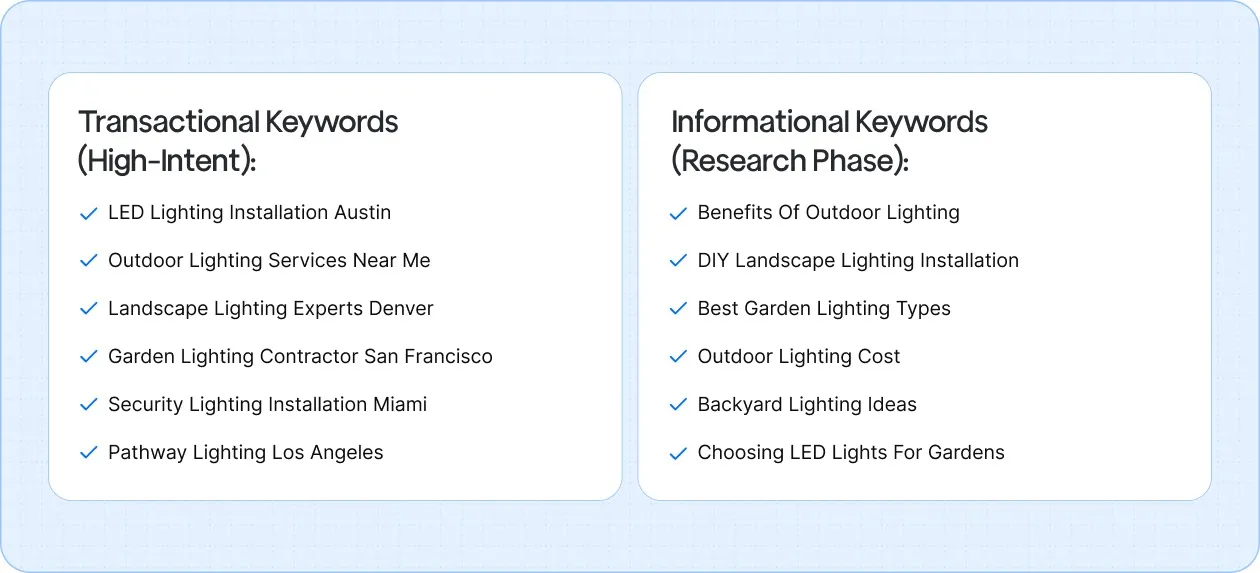
Optimizing your content for the right keywords is key to reaching people who need your services.
Content is an excellent tool for engagement.
Create content that connects with your audience and improves your SEO strategy with expert guidance.
Turn Content Into Customers
Core SEO Tactics
To truly stand out in local searches, SEO for landscape lighting companies is crucial. By implementing strategies like schema markup, quality backlinks, and strong technical SEO, you can increase your visibility and establish authority.
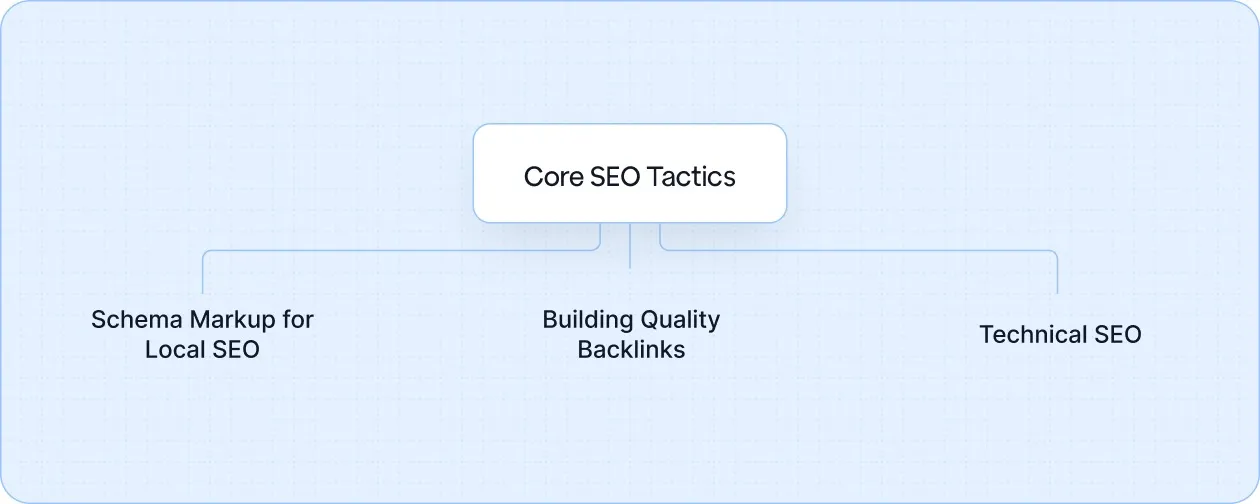
These efforts, backed by digital marketing services for landscape lighting firms, ensure that your business is found by the right local audience, driving long-term success.
Schema Markup for Local SEO
Implementing schema markup (like LocalBusiness and Service schema) is essential for improving SEO for landscape lighting companies. It helps search engines display your business details clearly in search results, increasing your visibility in local searches.
Why It Matters: With the right schema, your business appears in rich snippets, improving both visibility and trustworthiness.
For landscape lighting firms, this makes it easier for local customers to find you when searching for services like "outdoor lighting installation" or "garden lighting design."
Building Quality Backlinks
Acquiring quality backlinks from local business directories, industry blogs, and authoritative websites is a proven way to enhance SEO.
For digital marketing services for landscape lighting firms, these backlinks signal credibility to search engines, improving your site’s domain authority.
Why It Works: Trusted backlinks improve your ranking and establish your authority. A digital marketing agency for landscape lighting companies can help you build a strong link profile, driving local traffic and improving your SEO efforts.
Technical SEO
Technical SEO ensures your site is fast, mobile-friendly, and easy to crawl by search engines. These factors are crucial for providing a smooth user experience and improving rankings.
- Site Speed Optimization: Slow websites can deter visitors and harm rankings. Speed up your site by optimizing images and reducing redirects.
- Mobile Optimization: Since most searches are done on mobile, ensuring your site is responsive is essential for both user experience and search rankings.
- Crawl Settings: Ensure search engines can easily crawl and index your pages, making your services visible when users search for specific queries.
SEO requires you to build a solid foundation.
Get expert-driven SEO tactics that focus on improving your business's online presence.
Master SEO for Long-Term Success
Measuring SEO Success and Ongoing Optimization
To truly gauge the effectiveness of your SEO efforts, it’s essential to track key metrics and continuously refine your strategy.
Regular analysis helps you stay ahead by identifying areas of improvement and ensuring your landscape lighting business remains visible to the right audience.
Tracking SEO Metrics
To gauge the effectiveness of your SEO efforts, it's essential to keep an eye on key metrics that show how well your website is performing. These metrics help you understand what's working and where improvements are needed, ensuring your landscape lighting business stays visible to the right audience.
- Organic Traffic: This is the number of visitors coming to your site through search engines. An increase in organic traffic is a sign that your SEO for landscape lighting companies is gaining traction. Use tools like Google Analytics to track this and understand which pages attract the most visitors.
- Keyword Rankings: Monitoring the keywords your website ranks for is essential. By tracking these with Google Search Console, you can see if you're moving up in local search results for important terms like “outdoor lighting installation” or “garden lighting expert.”
- Conversion Rates: Ultimately, the goal is to turn visitors into customers. Filling out a contact form or calling for more information, tracking conversion rates helps you understand how well your site converts traffic into business. By analyzing this data, you can refine your content and calls-to-action to improve results.
Making Adjustments Based on Data
The key to sustained success is ongoing SEO optimization. Regularly reviewing performance data allows you to fine-tune your strategy and continuously improve your rankings.
- Why It Matters: As search trends change and competitors update their content, it’s important to stay adaptable. By analyzing the data insights from Google Analytics and Google Search Console, you can identify areas for improvement, such as optimizing underperforming pages or adjusting keyword targeting.
- Adjusting for User Engagement: High engagement signals to search engines that your content is valuable. If users are spending more time on your page or interacting with your content, it increases your SEO rankings.
Use insights from your data to keep optimizing content that resonates with your audience and adjust tactics that need more attention.
- Refining Your SEO Strategy: As the digital marketing services for landscape lighting firms evolve, you must be proactive in adjusting to new SEO trends, Google algorithm updates, and user behavior patterns. This ensures that your site remains competitive and visible in local searches.
Also Read: Your Landscaping Business Is Losing $10,000 A Month To Invisible SEO Mistakes. Here’s The Fix.
Start Implementing These SEO Strategies Today
Local SEO, content marketing, and continuous optimization are key to standing out and growing your landscape lighting business online.
Target the right keywords, create engaging content, and refine your strategies based on performance data. You set yourself up for long-term success and visibility in local searches.
There’s no better time than now to enhance your online presence with SEO that delivers results.
Reach out to Gushwork, the team that goes beyond the basics, and start seeing the impact.
Book a Free SEO Consultation
Digital Marketing
Dec 23, 2025
5 mins
Smart Marketing Budget for Your Plastic Rubber Business: Stretch, Flex, and Spend Wisely in 2026!
Batul Beawarwala
Marketing your plastic rubber business requires making smart, strategic choices with your budget. A well-planned budget helps you:
- Increase your brand’s visibility while controlling costs
- Reach the right audience with precision
- Stay flexible and adjust to shifting market trends
- Maximize ROI by focusing on high-impact strategies
With the right approach, your marketing budget becomes a powerful tool for growth in 2026. Let’s explore how to allocate your resources effectively and set your business up for success.
The Role of a Strategic Marketing Budget for Plastic Rubber Manufacturers
A well-planned marketing budget is crucial for driving growth and ensuring long-term success in the plastic and rubber industry. It helps you stay competitive, maximize ROI, and position your brand effectively. With the right budget, you can:
- Adapt to Market Fluctuations: Account for unexpected changes like raw material cost increases or shifting demand.
- Focus on Customer Retention: Maintain and grow relationships with existing customers while attracting new ones.
- Track What Works: Invest in strategies that deliver results and adjust your budget as needed.
Key Factors to Consider When Allocating Your Marketing Budget
Allocating your marketing budget effectively means targeting resources where they’ll have the greatest impact. Here are the key factors to guide your decisions:
a) Understand Your Target Market
Different customer segments, like manufacturers, automotive companies, and construction firms, have unique needs. Personalize your marketing to address those specific priorities: cost-efficiency for manufacturers, performance for automotive clients, and durability for construction firms.
b) Choose the Right Marketing Channels
Not all marketing channels are created equal. Trade shows are great for building B2B relationships, especially in industries like automotive and manufacturing. Digital marketing, on the other hand, offers long-term visibility and consistent engagement. Choose wisely to avoid overextending on low-return channels.
c) Effective Resource Allocation
Focus your budget on high-value areas. Invest in content marketing and SEO for sustainable brand growth. For immediate engagement, consider direct sales or event marketing, but remember to balance the costs with expected returns. Prioritize strategies that will scale as your business grows.
Must Read: Machinery Buyers Do 70% of Research Online Before Sales - Is Your Brand Visible In Search?
How to Calculate and Plan Your Marketing Budget for Plastic Rubber Products
When it comes to planning your marketing budget, precision is key. Allocating your resources effectively ensures your marketing efforts align with your business’s growth, production cycles, and market demands. Here’s how to approach it:
- Revenue-Based Budgeting: A common practice in the plastic and rubber industry is allocating around 5-10% of your revenue to marketing. This percentage provides a baseline, but you'll need to adjust it depending on your business size and market conditions.
- Cost Considerations: Your marketing budget should consider production cycles, fluctuating raw material prices, and demand forecasts. When material prices rise or production slows, you may need to adjust your budget accordingly.
This means prioritizing high-return marketing activities and scaling back on less impactful strategies.
- Seasonal Adjustments: The plastic rubber industry often experiences seasonal fluctuations based on market demand, industry trends, and external factors like regulatory changes. It’s crucial to adjust your budget based on these cycles.
For example, if you're in the construction segment, allocate more funds during peak seasons when projects ramp up.
Best Practices for 2026 to Optimize Your Marketing Spend
Maximizing your marketing budget requires spending smarter. To make every dollar work for you, here are the best practices to follow in 2026:
1. Data-Driven Decisions
Tracking key metrics like Customer Acquisition Cost (CAC) and Return On Investment (ROI) is essential to optimizing your marketing spend. By understanding how much you're spending to acquire a customer and the return you're seeing from each campaign, you can make informed decisions.
For example, if one channel has a high CAC but low ROI, consider reallocating funds to strategies that are performing better. Monitoring these metrics regularly will help you ensure that your spend is aligned with your goals and maximizing value.
2. Focus Areas for 2026
Prioritize high-ROI strategies like content marketing, SEO, and paid ads. Content marketing helps build long-term brand trust and improves organic traffic, offering sustained value over time. SEO helps improve your online visibility without constant costs, making it an essential part of your strategy.
3. Avoiding Overspend
Regularly assess your marketing channels to avoid wasting resources. If a channel isn’t performing as expected, scale back or cut it out altogether. Reallocate funds to areas that are showing higher returns.
A great way to do this is through A/B testing, which helps identify what works and what doesn’t, allowing you to refine your strategy. Stay flexible and ready to adjust your spend as needed, ensuring that your budget is always directed toward high-impact areas.
Must Read: Plastics and Rubber Manufacturers Must Adopt These 5 Strategies
Looking to drive smarter decisions and maximize your marketing impact?
With data-driven SEO and content strategies, you can focus your budget on high-ROI channels, ensuring long-term growth and maximizing every dollar spent.
Maximize Your ROI
Budget for the Future: Long-Term Marketing Planning
Planning for the long term is critical for staying ahead in the plastic rubber industry. While short-term adjustments are necessary, a growth-focused approach to budgeting will help secure your business's future. Here's how to set your marketing budget up for long-term success:
Growth-Focused Budgeting
Allocate a portion of your marketing budget for long-term initiatives that will fuel sustainable growth. Consider these areas:
- Brand Development: Invest in building a strong, recognizable brand that stands out in the marketplace. Over time, strong brand equity leads to customer loyalty and premium pricing.
- Product Diversification: Budget for expanding your product line to tap into new markets or respond to changing customer needs. Diversifying your offerings reduces risk and opens up new revenue streams.
- Global Market Expansion: As your business grows, targeting international markets can drive significant revenue. Set aside funds for market research, localization, and tailored marketing campaigns to ensure success in new regions.
Flexibility in Your Budget
A rigid marketing budget can hinder your ability to adapt to market shifts. Build flexibility into your plan to respond to unexpected challenges, such as:
- Regulatory Changes: New regulations may impact your production process or marketing strategy. Having a flexible budget allows you to reallocate funds to stay compliant.
- Raw Material Cost Increases: The volatility in raw material prices can impact your overall business operations. Adjust your marketing spend to ensure that you’re not over-committing to campaigns when production costs are high.
- Emerging Opportunities: Stay open to new marketing trends or technologies that could benefit your business. With flexibility, you can quickly invest in these opportunities before your competitors.
Quarterly Reviews
Regular budget reviews and performance audits help ensure that your marketing efforts are aligned with your business goals and market conditions. Consider the following:
- Measure Effectiveness: Track the performance of each marketing channel and assess whether it’s contributing to your long-term objectives. This allows you to reallocate budget to the most effective areas.
- Refine Your Strategy: Business priorities change over time, and so should your marketing strategy. Quarterly reviews give you the insight needed to adjust your budget and refine your approach to match new goals.
- Adjust Spending Priorities: Not all marketing channels will perform equally over time. By reviewing your budget quarterly, you can move resources from underperforming tactics to high-impact, revenue-generating activities.
Suggested Read: We Analyzed 25+ Top Manufacturing Websites - The Winners Follow These Simple Steps
3 Common Mistakes to Avoid in Plastic Rubber Marketing Budgeting
While creating a marketing budget is a crucial step for any plastic and rubber manufacturer, it’s equally important to avoid common pitfalls that can lead to wasted resources and missed opportunities.
Here are some key mistakes to watch out for:
1. Underestimating Marketing Costs
One of the biggest risks in budgeting is setting unrealistic expectations for your marketing spend. This often happens when:
- Creative Production: Often, businesses overlook the costs of producing high-quality content, videos, and other creative assets. These elements are essential for engaging your audience, but they require a significant portion of your budget.
- Solution: By setting aside a realistic budget for ongoing efforts and creative production, you’ll avoid running into shortfalls that can delay or derail your marketing initiatives.
2. Neglecting Performance Tracking
Without tracking the performance of your marketing activities, you risk overspending on underperforming tactics. Common issues include:
- No Clear Metrics: If you aren’t tracking metrics like ROI or customer acquisition cost, you’re essentially flying blind. You could end up spending on channels that aren't delivering value.
- Lack of Data Analysis: Regular analysis helps refine your strategy and improve future budgeting decisions. Without this, it’s easy to miss opportunities to optimize your marketing spend.
- Solution: Integrating regular performance reviews and real-time metrics into your marketing strategy allows you to track progress and adjust your budget accordingly.
Tools that offer automated reporting can help streamline this process and ensure you're staying on track.
3. Ignoring Competitor Strategies
Failing to monitor and analyze what your competitors are doing with their marketing can lead to missed opportunities. Here’s why it matters:
- Market Positioning: Competitors’ marketing strategies can provide insights into what’s working in your industry. If you’re not keeping track, you might miss key trends or innovations that could help you stay ahead.
- Avoiding Pitfalls: By understanding your competitors’ strengths and weaknesses, you can fine-tune your own strategy to avoid costly mistakes they may have already made.
- Solution: Regular competitor analysis helps you identify successful tactics, gaps in their approach, and new areas for growth. You can adapt these insights to improve your own marketing budget and execution.
Transform Your Plastic Rubber Marketing Budget for 2026
As we approach 2026, it’s clear that the key to long-term success in the plastic and rubber industry lies in a well-structured marketing budget. By strategically allocating resources, measuring performance, and staying adaptable, you can:
- Sustain Growth: A carefully planned budget ensures you can invest in the right channels and tactics, driving consistent growth and profitability.
- Stay Competitive: As raw material prices fluctuate and new competitors emerge, your marketing budget can help you stay agile and responsive.
- Maximize ROI: With data-driven decisions and regular reviews, your budget can evolve to focus on high-ROI strategies, giving you a competitive edge.
Your marketing budget should be a strategic tool that powers your business forward. It’s time to fine-tune your plan, adapt to new opportunities, and invest in initiatives that align with your long-term vision.
Want your marketing budget to drive real results?
Gushwork optimizes SEO and content strategies, helping you achieve lasting growth and maximize ROI.
Book a Free Consultation
SEO
Dec 23, 2025
5 mins
The Best SEO for Dry Cleaners Isn’t Complicated. Most Businesses Just Miss the 9 Basics
Ishani Mitra
Dry cleaning is a competitive, margin-sensitive business. New stores open, delivery apps enter the market, and customers switch providers more easily than before. In that environment, being good at the service is no longer enough. Visibility plays a direct role in whether your business grows, plateaus, or slowly loses ground.
SEO, with its new and best upcoming trends, have become one of the few channels that compounds over time for dry cleaners.
In this blog, we break down what the best SEO for dry cleaners looks like in 2025, the strategies that actually influence local growth, and which SEO services are best positioned to support long-term, organic performance.
Understanding Why SEO Matters for Dry Cleaners in 2026
SEO for dry cleaners in 2026 is still about one core goal: getting nearby customers to choose your store when they need cleaning services. What has changed is how search engines decide who gets shown and why. Search is more contextual, more local, and more selective about which businesses it trusts.
To compete today, dry cleaners need to focus more on clarity, accuracy, and real usefulness at the exact moment a customer is ready to act.
What’s New in SEO for 2026?
2025 accelerated three trends you can’t ignore: AI-driven result summaries, stricter helpful-content signals, and an even stronger emphasis on mobile and local signals.
- AI-influenced search results: Search engines increasingly summarize and recommend businesses using structured, easy-to-understand information. Clear service pages and well-organized content matter more than ever.
- Stronger emphasis on helpful content: Pages that directly answer customer questions about turnaround time, pricing ranges, pickup options, and garment care perform better than vague marketing copy.
- Greater weight on local signals: Local Pack algorithms now weigh relevance, distance, reviews, and real-time signals. Up-to-date business listings, proximity, and consistent local mentions play a larger role now.
- Mobile-first expectations: Most searches happen on phones. Fast load times, click-to-call buttons, and simple navigation are now basic requirements.
For dry cleaners, these changes reward businesses that are easy to understand, easy to trust, and easy to contact.
Key SEO Trends for Dry Cleaners in 2026
In 2026, SEO for dry cleaners is shaped by one reality: search engines are trying harder to behave like customers.
These trends reflect how search engines now assess local service businesses and what dry cleaners must prioritize to remain visible and competitive:
Local SEO Strategies for Dry Cleaners
Local SEO remains the primary driver of discoverability for dry cleaners. Most searches are immediate, and customers typically choose from a small set of nearby options surfaced in Maps or local results.
- Google Business Profile (GBP)
- Complete every field: primary category, secondary categories, services, business hours (include holiday hours), and appointment link.
- Use service-level entries (e.g., “wedding dress cleaning”, “same-day shirt press”) so Google can match queries to exact services.
- Upload fresh photos weekly and post short updates (promotions, turnaround times, service changes).
Get Chosen in Local Search
Turn your Google Business Profile into clear decision points that drive calls and walk-ins.
Optimize My GBP
- Local content and keywords
- Create short, focused pages.
- Use neighborhood names, nearby landmarks, and route/pickup areas in copy and meta tags.
- Add a small pickup-route page or calendar that shows neighborhoods and pickup windows.
- Reviews and reputation process
- Automate a post-service review prompt (SMS/email) within 24 hours; ask for specific details (service, turn-around).
- Respond to every review within 48 hours; for negative reviews, offer a clear remediation step.
- Track review velocity and average rating monthly; aim to keep recency and response time high.
AI-Powered Search & Conversational Queries
AI now shapes and surfaces question-type and comparison queries. Clear, structured, question-and-answer content is more likely to be pulled into AI overviews and conversational results.
- Write for conversational intent
- Add concise FAQ blocks with single-sentence answers (good for AI extraction).
- Use natural phrasing. Write the questions people actually ask.
- Optimize for voice searches
- Include full-phrase long-tail queries and “near me” variants in FAQs and schema.
- Create a short “quick answers” section on each service page for mobile/voice consumption.
- Monitor AI visibility
- Use rank-tracking tools that report AI / “People also ask” visibility.
- If AI overviews surface for your keywords, test short fact-driven content to get cited.
Content Quality, Authenticity, and E-E-A-T
Google prioritizes content that shows real experience, expertise, authority and trust. For dry cleaners that means practical, local, and experience-led content.
- Demonstrate Experience and Expertise
- Publish short case studies (before/after + what was fixed and why).
- Create a credentials section: certifications, years in business, handling special fabrics.
- Authoritativeness and trust signals
- Link to or cite manufacturer care instructions or textile associations when relevant.
- Collect and display third-party reviews (Google, Yelp, Trustpilot) and badges (Better Business Bureau, local chamber).
- Content formats that win
- Well-structured answers can appear in Featured Snippets
- Clear Q&A content helps surface in People Also Ask results
- Concise explanations are more likely to be referenced by AI summaries
Answer What Customers Ask
Create content that explains turnaround times, garment care, and services in plain language customers trust.
Build Helpful Local Content
Website Performance, Mobile UX and Core Web Vitals
Search rewards pages that load fast and behave predictably, on mobile first. Core Web Vitals are still central: faster pages convert better and keep rankings stable.
- Mobile-first checks (immediate wins)
- Ensure tap-to-call is front-and-center on every page and booking forms are one-screen on phones.
- Remove intrusive interstitials and reduce heavy slider galleries.
- Core Web Vitals optimization
- Prioritize LCP (largest contentful paint) and CLS (visual stability): compress hero images, reserve space for images/ads.
- Use lazy-loading for below-the-fold images and server-side caching or CDN.
- Tools and cadence
- Run PageSpeed Insights and Lighthouse; focus on mobile results.
- Track Core Web Vitals in Search Console and fix pages with poor field data first.
Make Your Website Convert
Help customers understand your services, pricing cues, and pickup options the moment they land.
Improve My Dry Cleaning Website
Schema & Structured Data
Structured data helps search engines and AI understand your services and increases eligibility for rich snippets, hours, and FAQ cards.
- Priority schema types for dry cleaners
- LocalBusiness (with openingHours, geo, address)
- Service / Offer (for service types and price cues)
- FAQ and HowTo (for quick answers and voice/AI extraction)
- Review (connects rating to rich snippets)
- Implementation steps
- Generate JSON-LD with a schema helper for one service page; test in Rich Results Test.
- Add structured data for your GBP using the same details to keep consistency.
- Monitor Search Console for structured data errors and fix promptly.
On-Page & Technical SEO (long-tail, speed, UX)
Technical hygiene and targeted on-page optimisation are how you convert local visibility into bookings.
- Long-tail and service-specific pages
- Build pages for phrases that convert: “wedding dress cleaning in [neighborhood]” or “same-day suit press [city]”.
- Keep each page focused on one intent and avoid thin, duplicated content.
- Page speed & resource management
- Replace large background videos with stills; serve images in modern formats (WebP/AVIF).
- Remove unused plugins and consolidate tracking scripts via Google Tag Manager.
- Responsive, accessible UX
- Use large CTAs, clearly labelled pickup options, and an easy booking flow (name + phone minimal).
- Provide visible trust signals (ratings, guarantees) above the fold on mobile.
Off-Page SEO: Link Building & Local Citations
Local links, contextual mentions, and accurate directory listings still matter — but quality beats quantity. A few relevant local links move the needle more than dozens of unrelated directories.
- Local link targets
- Tailors, bridal shops, dry-clean-friendly hotels, local event pages, community charities.
- Get featured in “local services” guides and neighborhood blogs.
- Tactics that work
- Co-create a short guide with a bridal boutique (“how to prepare your gown for cleaning”) and earn a link.
- Sponsor a community event and secure an event page mention/backlink.
- Citation hygiene
- Audit NAP across top directories (GBP, Yelp, Apple, Yellow Pages, local chamber) and fix inconsistencies.
Show Up When It Matters
Capture local search demand from customers already looking for dry cleaning near them.
Strengthen My SEO
Trust Signals and Conversion Triggers
Trust elements are ranking signals and conversion drivers. Treat them as a single system.
- Critical trust elements
- Consistent NAP, SSL, visible reviews, clear refund/repair policy, and staff credentials.
- Conversion placements
- Place 1–2 trust elements (rating, guarantee badge) next to CTAs and booking forms.
- Use short social proof lines: “3,200 garments cleaned in 2025 — 4.8★ average.”
Measure, Report, and Iterate
Track a small set of high-value KPIs and review them weekly. Metrics should tie back to revenue and repeat business.
- Primary KPIs
- Calls/bookings attributable to organic & GBP traffic (use call tracking)
- Conversion rate by page (service pages, pickup form)
- Average order value and repeat-customer rate
- Tools and setup
- Google Analytics + GA4 events for form submissions and phone clicks
- Google Search Console for queries and indexing issues
- Call-tracking (CallRail/Twilio) with UTM tagging for campaign attribution
- Review cadence
- Weekly: GBP insights, calls, and urgent site errors
- Monthly: organic traffic, conversions, review velocity, Core Web Vitals trends
- Quarterly: backlink profile, local market share, pricing/offer tests
5 Best SEO Services That Can Help Dry Cleaners Grow Organically Online
The services below stand out for their ability to support local service businesses and drive steady, organic growth when executed correctly.
1. Gushwork
Gushwork focuses on SEO that is built around how local service businesses actually get customers. For dry cleaners, that means showing up at the exact moment someone searches nearby, understands the service quickly, and takes action without friction.
What makes Gushwork a strong fit for dry cleaning businesses:
- Local-demand–driven SEO strategy: Gushwork structures SEO around real search behavior. The goal is to capture demand that already exists, not manufacture traffic that doesn’t convert.
- Deep Google Business Profile optimization: GBP is treated as a primary acquisition channel, not a checkbox. Gushwork actively works on service categorization, profile content, posting cadence, review signals, and visibility factors that influence Maps rankings and call volume.
- Conversion-focused content: Pages are written to answer practical questions customers care about: turnaround time, garment types, pickup options, and pricing cues. This reduces hesitation and increases conversion, especially on mobile.
- Strong technical and local SEO foundation: Site speed, mobile usability, indexing, and local schema are handled, so rankings are not lost to technical gaps. This ensures SEO improvements actually stick and compound over time.
- Clear connection between SEO and revenue: Reporting focuses on calls, bookings, and customer actions. This makes it easier for dry cleaners to understand what’s working and where growth is coming from.
- Built for sustainable growth: The approach prioritizes steady local visibility and repeat demand, helping dry cleaners reduce reliance on paid ads and promotions over time.
For dry cleaners that want SEO to translate into predictable foot traffic and pickup requests, Gushwork offers a focused, practical approach grounded in how local service businesses really grow.
2. WebFX
WebFX is a well-known digital marketing agency with experience across multiple local service industries. Their SEO services are structured and scalable, making them suitable for dry cleaning businesses with multiple locations or expansion plans.
Strengths include:
- Structured local SEO and on-page optimization
- Strong technical SEO capabilities
- Access to proprietary reporting tools
However, their approach can feel standardized, which may require additional customization for niche local services.
3. Thrive Internet Marketing Agency
Thrive focuses on local SEO and reputation management, which aligns well with dry cleaners that rely heavily on local trust and visibility.
Notable areas:
- Google Business Profile optimization
- Review generation and management
- Content and citation-focused local SEO
Thrive works best for businesses that want consistent local presence improvements rather than aggressive growth experimentation.
4. Straight North
Straight North specializes in lead-driven SEO and works with service businesses that prioritize inbound inquiries. Their approach is data-heavy and conversion-focused.
Key offerings:
- SEO strategies tied to lead generation
- Strong emphasis on tracking and attribution
- Balanced focus on content and technical SEO
This can be a good fit for dry cleaners that already understand their funnel and want to optimize performance.
5. Victorious SEO
Victorious SEO is known for its technical depth and enterprise-grade SEO execution. While not exclusively focused on local services, their strategies can benefit larger or multi-location dry cleaning operations.
Where they perform well:
- Advanced technical SEO and audits
- Keyword strategy and competitive analysis
- Scalable SEO frameworks
For smaller dry cleaners, their services may feel more complex than necessary, but they can be effective at scale.
Conclusion
The best SEO for dry cleaners is about building a strong local presence that holds up over time. Accurate listings, clear service pages, solid technical foundations, and steady trust signals create an advantage that competitors can’t easily copy.
As search continues to evolve, dry cleaners that invest in SEO as a long-term growth channel will rely less on discounts, paid ads, and one-off promotions. Instead, they’ll benefit from consistent demand and stronger brand recognition in their local market.
When SEO is treated as an asset rather than an experiment, it becomes one of the most reliable ways to grow a dry cleaning business organically.
Ready to Grow Organically
Get a clear SEO plan built around local visibility, conversions, and repeat customers.
Book A Consultation

Digital Marketing
Dec 23, 2025
5 mins
Smart Home Wiring Partner Marketing Only Works When You Apply These 15 Strategies
Ishani Mitra
As more people turn their homes into smart, connected spaces, the need for skilled wiring professionals has never been greater. But with so many businesses offering similar services, how do you stand out?
The answer lies in effective marketing. The right skills does get the job done. But it’s more about ensuring potential customers know you’re the one to trust for their smart home needs.
In this blog, we’ll explore practical marketing strategies to help your smart home wiring business build strong partnerships, attract the right clients, and position yourself as the go-to expert in this booming industry.
Understanding the Smart Home Technology Industry
The smart home technology industry operates at the intersection of innovation and trust. Buyers are often interested but cautious, evaluating solutions based on reliability, integration, and long-term value rather than novelty alone.
This makes marketing less about awareness and more about helping prospects understand where a solution fits, how it works in real environments, and why it’s a safe decision.
Below are the manufacturing marketing challenges most smart home technology companies face:
- Rapid Innovation Creates Buyer Confusion: New protocols, devices, and standards appear constantly. It overwhelms buyers who struggle to understand the differences between systems, integrations, and long-term viability.
- Highly Technical Offerings Are Hard to Explain: Smart home solutions are not impulse purchases. They involve wiring, infrastructure, compatibility, and future-proofing. Without clear positioning, technical depth becomes a barrier instead of an advantage.
- Long, Multi-Stakeholder Sales Cycles: Decisions often involve builders, electricians, integrators, property owners, and end users. Each stakeholder has different priorities, which slows adoption when messaging is unclear or inconsistent.
- Crowded Vendor and Partner Ecosystems: Manufacturers, installers, and integrators often compete for the same projects. Many offer similar capabilities, making it difficult for buyers and partners to distinguish one provider from another.
- Strong Reliance on Referrals and Relationships: The industry still depends heavily on word-of-mouth and existing networks. While effective, this limits scale and creates unpredictable revenue pipelines.
- Limited Visibility Beyond Immediate Networks: Without proactive visibility, even capable smart home businesses remain unknown outside their current partner circle, missing opportunities earlier in the decision process.
How Can Marketing Solve These Challenges?
- Clarifies Complex Offerings for Different Audiences: Structured messaging helps explain technical capabilities in a way each stakeholder can understand, reducing friction in the sales process.
- Supports Longer Sales Cycles With Consistent Visibility: Marketing and SEO keep businesses present throughout research and planning stages, not just at the point of purchase.
- Strengthens Differentiation in Competitive Markets: Clear positioning and proof-driven content make it easier for buyers and partners to see what sets one provider apart.
- Expands Reach Beyond Existing Relationships: Marketing introduces smart home businesses to new builders, integrators, and property owners before referrals would typically occur.
- Builds Trust Before Direct Contact Happens: Educational content, case studies, and visibility across channels establish credibility before conversations begin.
- Creates Predictable Demand Over Time: Marketing supports a more consistent and scalable growth pipeline.
This shift allows smart home technology businesses to grow without disrupting how projects are sold or delivered, while staying competitive in this industry.
14 Proven Strategies to Promote Smart Home Technology
Smart home services sit at the intersection of electrical expertise and modern home improvement. Promoting them effectively requires a mix of education, visibility, and trust-building, especially in a market where most customers are still learning what’s possible.
The strategies below reflect how businesses can market smart home wiring and setup services to align with buyer intent in the home improvement services market.
1. Target the Right Customers for Smart Home Services
Smart home technology is best marketed to people who are already thinking about improving their homes. Targeting the wrong audience leads to confusion and wasted effort.
- Focus on homeowners already planning upgrades: These are people already planning renovations, new builds, or system upgrades. They are more open to smart home discussions because they are already making decisions about their home’s future.
Best practices:- Prioritize renovation and remodeling inquiries
- Look for new home buyers or recent movers
- Pay attention to customers asking about security, lighting control, or energy efficiency
- Match your message to their main motivation: Different customers care about different outcomes. Your messaging should reflect why smart home technology matters to them, not how advanced it is.
Steps to apply:- Plan the high-intent keywords to determine their customer journey
- Frame one discovery question around it (“What made you consider smart home options?”)
- Decide recommendations based on their answer
- Avoid introducing features they didn’t ask for
Reach the Right Smart Home Buyers
Identify who is actively searching for smart home wiring and what they are typing into Google before they call anyone.
Build My ICP and Keyword Map
2. Website Optimization and SEO for Smart Home Services
Your website should clearly explain your smart home services in simple terms. SEO, at its core, is about making sure people can find those explanations when they search online.
- Create dedicated pages for smart home services: Smart home wiring should be clearly separated from general electrical services so visitors understand it’s a specialized offering.
Best practices:- One page per smart home service type
- Simple explanation of what’s included
- Clear “Who this is for” section
- Make it easy for local customers to find and contact you: Most people search for services near them. Mentioning your service areas and keeping your business information consistent helps your site appear in local searches.
Steps to follow:- Mention cities and service areas naturally on the page
- Place phone number and booking button near the top
- Keep contact details consistent everywhere online
Get Found When Decisions Start
Show up in local searches where homeowners and builders compare smart home wiring options.
Improve My Smart Home SEO
3. Showcase Detailed Smart Home Project Case Studies
Case studies replace uncertainty with proof. They show customers what smart home work actually looks like in real homes.
- Walk through real projects step by step: Walk readers through what the customer needed, how you approached the wiring or setup, and what the final result looked like.
Structure to use:- What the homeowner wanted
- What wiring or setup was required
- What the final result enabled
- Highlight practical benefits: Focus less on technical features and more on how the installation improved daily life.
Focus on:- Easier control of lighting or devices
- Improved security or monitoring
- Homes ready for future upgrades
4. Social Media and Paid Ads for Smart Home Wiring
Social media and ads are most effective when they show real work and stay educational rather than promotional.
- Use social media to show real installs: Regular posts help people recognize your business and understand what smart home work looks like.
Best practices:- Short videos explaining what’s happening
- Before-and-after photos
- Simple captions that explain value
- Use paid ads to stay visible during research: Ads are most effective when they support learning, not pressure decisions.
Steps to apply:- Promote consultations or video guides instead of hard sales
- Retarget people who visited smart home pages
- Keep ad copy benefit-focused and simple
5. Create Educational Content That Builds Trust
Most smart home objections come from uncertainty. Educational content helps remove that uncertainty before the sales conversation starts.
- Explain smart home concepts in everyday language: Content should answer basic questions without assuming technical knowledge.
Topics to cover:- What smart home wiring enables
- Why planning early saves money later
- How systems can expand over time
- Use content during sales conversations: Educational articles and guides can be shared during consultations to reinforce what you explain verbally.
Best practices:- Share links after consultations
- Use guides as follow-up resources
- Answer common objections proactively
Turn Expertise Into Demand
Create content that explains smart home wiring clearly and builds trust before the first conversation.
Create High-Intent Content
6. Collect and Leverage Customer Feedback
When customers talk about their experience, it carries more weight than any marketing message.
- Request reviews focused on smart home work: Specific feedback builds more confidence than generic praise.
How to ask:- Request reviews shortly after project completion
- Suggest mentioning what changed in their daily life
- Use testimonials where decisions happen: Visibility matters more than volume.
Places to feature:- Smart home service pages
- Quotes in proposals
- Highlighted social posts
7. Partner With Smart Device Manufacturers for Co-Marketing
Manufacturer partnerships make your services feel safer and more credible to customers unfamiliar with smart home technology.
- Align with brands customers recognize: Familiar names help reduce perceived risk and make recommendations easier to accept.
Best practices:- Display partner logos on service pages
- Explain compatibility clearly
- Create simple bundled offers: Bundles help customers understand value without complexity.
Examples:- Wiring plus device setup
- Starter packages with upgrade options
8. Link Building
Link building strengthens search visibility by showing search engines where your business fits in the smart home ecosystem.
- Earn links from builder, contractor, and integrator partner sites
- Get listed in industry associations and trade directories
- Contribute guest content to construction or smart home blogs
- Focus on links that align with your services and markets
9. International Marketing
International SEO and marketing apply when your services or partnerships extend across regions or countries. The goal is controlled expansion, not broad global reach.
- Create region-specific pages and keyword targeting
- Adapt messaging to local standards, regulations, and terminology
- Highlight certifications and compatibility clearly
- Build partnerships with regional builders or distributors
10. Offer Free Consultations and Live Demonstrations
Seeing and discussing options in person helps customers feel confident in their decisions.
- Use consultations as planning sessions: Free first conversations build trust.
Steps to follow:- Walk through the home
- Explain immediate and future options
- Recommend phased setups
- Demonstrate when possible: Showing systems in action builds confidence faster than explanations.
11. Run Targeted Digital Advertising Campaigns
Marketing works best when it explains benefits clearly and speaks to real-life situations.
- Focus messaging on benefits: Customers relate to how technology improves life. Run ads based on:
- Convenience and control
- Peace of mind
- Future flexibility
- Keep ads simple and relatable: Avoid technical language that creates doubt.
12. Digital PR
Digital PR helps smart home wiring businesses build visibility and trust in places partners and buyers already pay attention to. The focus is on credibility.
- Get featured in construction, real estate, and smart home publications
- Share expert insights on wiring standards, future-ready homes, or retrofit planning
- Publish data-backed stories from real projects or installations
- Support SEO by earning authoritative, context-relevant mentions
13. Host Webinars and Educational Workshops
Workshops allow customers to learn without feeling pressured to buy.
- Teach fundamentals clearly: Explain how your systems are set up, how they work together and why wiring matters.
- Use audience questions as insight: Questions reveal what customers struggle to understand. The questions people ask help refine future messaging and content. Use these questions to frame and improve your delivery.
14. Implement an Online Booking System
Interest drops quickly when scheduling is difficult. When a buyer tries to reach out to you, you must ensure every path is simple for them.
- Make scheduling easy and immediate: Online booking captures intent when it’s highest.
Best practices:- Mobile-friendly booking
- Clear confirmation and follow-up
Measuring the Success of Your Smart Home Technology Promotion
Smart home marketing only delivers value when performance is tied back to real outcomes. Visibility alone is not enough. What matters is whether interest turns into inquiries, projects, and long-term clients.
The focus should be on how promotion efforts translate into qualified leads, completed installations, and repeat work.
Key metrics to monitor:
- Inquiry-to-consultation rate: Shows how many website visits or ad clicks turn into actual discovery calls or site assessments.
- Lead quality by channel: Helps identify which platforms bring serious buyers versus early-stage researchers.
- Cost per qualified lead: More useful than cost per click when evaluating campaign efficiency.
- Project conversion rate: Measures how many consultations result in approved wiring or automation projects.
- Customer lifetime value: Indicates whether marketing attracts one-time installs or long-term upgrade clients.
Tools and Resources for Effective Smart Home Marketing
Smart home marketing becomes easier to manage and scale when the right tools and partners are in place. The goal is to use the tools that directly support lead quality and loyalty returns.
The focus should be on tools that help attract the right prospects and clearly measure what each channel delivers.
Lead generation partners to consider:
- Industry-specific lead providers: Services that focus on home services or smart technology tend to deliver more relevant inquiries than broad marketplaces.
- Local lead generation platforms: These often perform better for installation and wiring services tied to specific service areas.
- Performance-based partners: Prioritize vendors that offer clear reporting and accountability for lead quality.
If you want a partner that covers all of this without the usual guesswork, Gushwork combines industry-specific targeting, local demand capture, and performance-driven reporting to deliver SEO that is built to convert.
SEO and PPC tools that support optimization:
- SEMrush or Ahrefs to track keyword rankings, competitor performance, and backlink opportunities
- Google Keyword Planner to identify demand, seasonality, and cost estimates for paid campaigns
- Google Analytics to evaluate traffic behavior and conversion paths
- Google Search Console to monitor search visibility, indexing issues, and page performance
Using these tools consistently helps identify what’s working, where gaps exist, and which efforts deserve more focus. Over time, this creates a clearer, more efficient smart home marketing system.
Conclusion
The smartest growth in smart home wiring comes from earning placement.
When your business is woven into the way projects are planned, discussed, and handed off, marketing stops feeling like work. You’re not convincing people you’re capable. Your name comes up because it belongs there.
You don’t need to be everywhere. You need to be in the right rooms, with the right people, at the right moment. Build those connections well, and your business stops reacting to demand and starts shaping it.
Ready to Grow With Clarity
Get a clear plan to attract better smart home projects without relying only on referrals.
Book A Consultation

“For the first time, we’re proud to add SEO services. Six months in, impact evident.”
Read Case Study

In Conversation with

Abhijith HK
Founder & CEO of Codewave
Want us to do the same for your business?
Talk to an Expert
.svg)
.svg)

