


.svg)


.svg)
.svg)
Schedule a Call
Get started with your organic growth journey!


200+ Calls Booked Last Month

Get insights on AI, productivity, and the future of work.



Laundry services sell something people use often but think about very little. That’s the challenge. When a service feels ordinary, customers default to whatever name they notice first or whatever option seems simplest. Marketing becomes the tool that lifts your business out of that blur. It shows people what makes your service worth choosing, even when they aren’t actively comparing providers.
Marketing also shapes expectations. It tells customers what quality looks like, what convenience should feel like and what level of care they can expect from a professional service. Without it, every provider seems the same, which pushes buyers to choose based on confusion.
In this blog, you’ll learn how laundry service marketing actually works today, what drives customers to choose one provider over another and the practical strategies that help your business stay top-of-mind when people need help the most.
Laundry service marketing is the process of attracting more customers to your pickup-and-delivery or in-store service by improving your visibility, building trust, and consistently communicating your value across online and offline channels.
Unlike traditional retail, laundry relies heavily on:
Marketing for laundry services focuses on showing up in local searches, creating a smooth digital experience, building credibility through reviews, and using well-timed promotions to turn first-time users into loyal weekly customers.
Marketing a laundry service is about being visible where your customers already are: on their phones, in their apartment buildings, at local businesses, and in their inboxes. These strategies work best when you use them together:
Digital marketing is how your laundry business appears online: your website, your content, your online ads, and the words people use to find you (keywords). For a local laundry, this is often the first impression someone gets before they ever see your shop or van.
What your setup should include:
Your website should explain your service clearly and make booking simple. Most customers skim, so clarity matters more than design trends. A good website removes confusion and reduces the number of questions you’re answering over the phone.
What to include:
Good content helps customers understand how your service works and reduces uncertainty for first-time users. It also builds authority with Google, helping you rank for the terms people search.
Useful content ideas:
How to present it:
Explain your process clearly, answer real customer questions, and turn first-time visitors into confident first-time users.


Keywords are the terms customers type into Google when they need laundry services. Using them naturally on your website helps search engines understand what you offer and where you serve.
Keywords to target:
Where to place keywords:
Use them naturally, never force them.
Get clarity on your ideal customer and the search terms they use so your marketing attracts the right people from day one.
PPC (Pay-Per-Click ads) puts your business in front of people who need laundry service right now, especially useful for urgent, same-day, or pickup-focused searches. It’s the quickest way to get bookings while your SEO is still growing.
How to run effective PPC:
Digital marketing is your “always on” engine, even when your shop is closed, your website and ads can still bring you new customers.
SEO (search engine optimisation) is about making sure Google understands:
So when someone searches, you show up without paying for every click.
You need the following to speed things up:
Ensure your business details are identical on:
Consistency helps Google trust your information.
Make your site easy to understand by:
Build trust outside your site:
This combination tells Google: “We are the laundry service people here actually use.”
Strengthen your search visibility with SEO that highlights your services, service areas, and reliability.
Local physical branding is everything people see in the real world: your bags, your vans, your storefront, your flyers. It helps people connect the online brand they saw on their phone with a real, trustworthy business.
What to focus on:
Branded laundry bags give your business visibility wherever customers carry them. Adding your logo, contact details and a simple prompt like “Scan to schedule your next pickup” turns every bag into a quiet ad that moves through apartments, offices and shared spaces.
Vehicle branding works the same way. Even simple magnetic signs help people associate your name with pickup and delivery. Keep the message clean with your brand name, service type, service area and a quick way to contact you. Parking in areas where your ideal customers live or work reinforces that recognition.
Your storefront should communicate your services at a glance. Clear lines such as “Pickup and Delivery Available” or “Wash and Fold by [time]” make it easy for people to understand what you offer. Clean windows, readable signage and visible hours help passersby trust and remember you.
Physical touchpoints extend your visibility further. Door hangers in approved buildings, flyers in gyms or co-working spaces and partner placements in student housing or serviced apartments all keep your name in front of people who are likely to use a laundry service.
Good physical branding backs up your digital efforts and builds familiarity: “I’ve seen that name before.”
Social media for laundry is about being visible and trustworthy, where your customers scroll daily. Paid social ads (Facebook, Instagram) help you target people in your exact service area.
What to post
Paid social works best when you keep the targeting simple and rooted in location. Focus on ZIP codes, a radius around your shop or specific audience segments if they make sense for your market such as students, young professionals or families.
Your ads should highlight offers that are easy to understand. Intro discounts, new area launches or subscription plans tend to perform well because customers can act on them without much thought.
Make sure every ad sends people somewhere that reduces friction. A straightforward landing page works well, but direct options like messaging, WhatsApp or click-to-call often convert faster for local services.
Social media builds familiarity. Paid ads turn that familiarity into first orders.
Email and SMS marketing help you stay in touch with people who already know you. For laundry services, retention is everything, it’s more valuable to keep a weekly customer than to chase new people every day.
How to use it:
Email and SMS work best when they guide customers through simple steps. A welcome sequence after the first order sets the tone. Thank them, show them how to schedule their next pickup and share a brief note about how you care for their clothes. This creates confidence and makes repeat use easier.
Reminders help maintain momentum without feeling pushy. Short messages like “It’s been two weeks since your last pickup, want us to swing by?” or “Spots open for tomorrow’s route in [Neighbourhood]” keep your service top of mind and make it easy for customers to act with one tap.
Keep messages short, friendly, and clear. People check their phones quickly. Do not overload.
Every interaction, WhatsApp message, phone call, pickup, delivery, shapes how people talk about your business. Good communication becomes free marketing; poor communication destroys it.
What you need to setup:
When customers feel informed and respected, they’re far more likely to stay, refer, and forgive small mistakes.
Your existing customers are your best marketers. Reviews build online trust. Loyalty rewards keep people from drifting to competitors. Referrals bring you similar, high-quality customers.
What to do
These levers help you move from one-off jobs to predictable, repeat revenue.
Technology doesn’t replace good service; it supports it. The right tools make it easier for customers to book, and for you to track what’s working.
Useful tools
Even simple tools (Google Sheets + a basic CRM or booking app) can give you enough data to decide where to spend your time and money.
A marketing plan for a laundry business doesn’t need to be complicated. It should simply tell you what you’re trying to achieve, who you’re targeting, where you’ll focus, and how you’ll measure progress:
Before you choose channels or tactics, you need to know what “success” looks like. Clear objectives stop you from chasing random ideas and help you decide where to invest time and money.
Not everyone is your customer. A clear picture of who you serve and where they live makes all of your marketing more focused and cost-effective.
If your routes are too wide or random, your costs will affect your profits. Service rules keep operations efficient while you grow.
Your marketing budget should reflect your goals and what you can realistically manage each month.
For laundry services, reviews and word-of-mouth are often more powerful than any advert. Making reviews part of your process keeps trust growing steadily.
You just need a small set of numbers you track consistently so you can see what’s working.
Here’s are some challenges you face in marketing, when they are not part of your daily process:
People search “laundry near me” or “pickup and delivery laundry” and click the top three results. If competitors invest in SEO, ads, and Google Business Profile updates, they appear instantly, while your listing stays buried. Over time, you stop being an option, even for customers right in your service area.
Without ongoing marketing, you rely on walk-ins, occasional referrals, or random demand spikes. This leads to:
When you ignore marketing, every customer feels “hard-earned.” You may spend more on discounts or last-minute promotions because you’re not building long-term visibility. Businesses with consistent online presence enjoy lower acquisition costs because customers find them organically over time.
Laundry services thrive on repeat customers, weekly, bi-weekly, or monthly. When marketing is absent:
Marketing ensures customers stay engaged, come back consistently, and refer others.
Without consistent demand, it’s difficult to:
Laundry is one of those services people rarely plan for, yet rely on constantly.
Marketing for your laundry service puts you top of mind the moment someone needs a pickup. Build that clarity. Build that trust. And your laundry service becomes the first choice, not the backup option.
Your next loyal customer might be one busy day away. Let your marketing make that decision simple.
Let’s shape a plan that brings you steady orders, consistent visibility, and loyal customers.

Most homeowners don’t have a “go-to” drain cleaner. They don’t keep a list of specialists. They don’t know which companies are genuine experts, and they definitely can’t tell the difference between a pro who’s been in business for a decade and someone who started last month.
So what do they rely on?
This is why drain cleaning leads go to businesses that present themselves clearly, show proof instead of promises and look like they’ll actually pick up the phone.
In this blog, you’ll learn how drain cleaning customers really choose a provider, what drives them to trust one contractor over another and the exact strategies that turn that trust into a steady pipeline of high-quality leads.
Drain cleaning leads stand out because they convert fast, produce ongoing work and often turn into higher-value jobs.
Homeowners usually experience drain issues without warning, which pushes them to hire immediately instead of shopping around. This urgency, paired with the natural add-on services that follow, makes drain cleaning one of the strongest revenue drivers in home services.
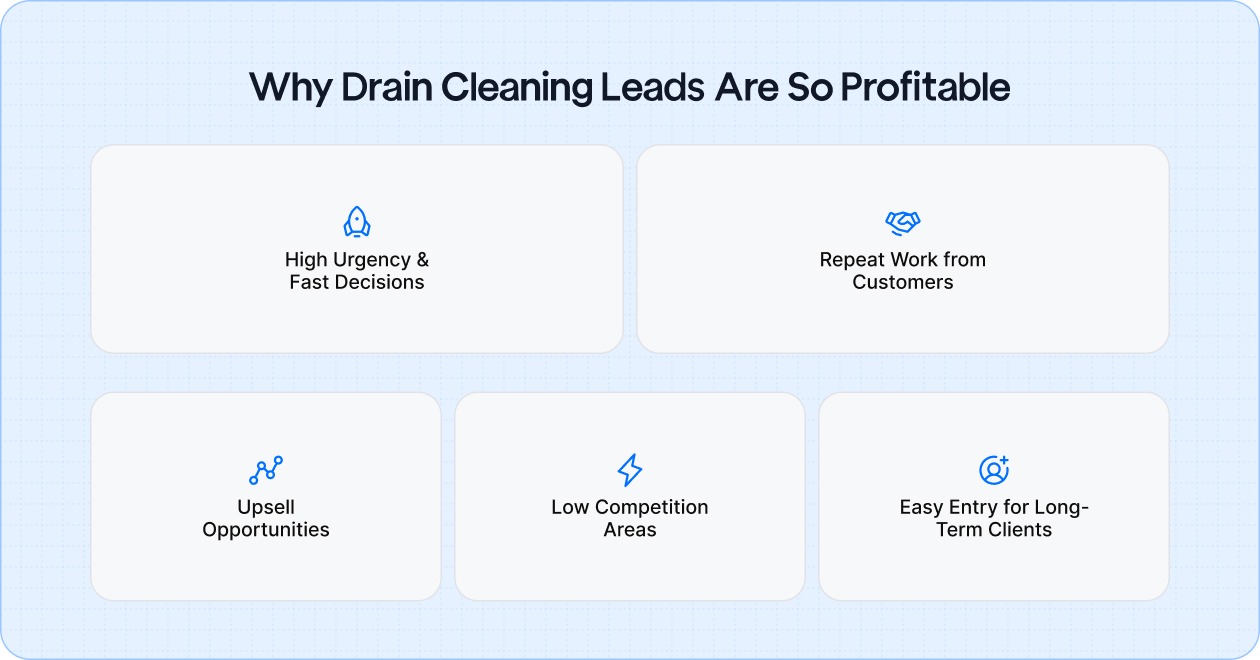
Here’s what makes these leads so profitable:
Below are the core factors that shape drain cleaning lead generation today:
Homeowners respond very differently depending on the severity of the issue.
Understanding both behaviours helps you position your marketing for both instant calls and long-term awareness.
Three factors control whether a drain cleaning lead becomes a booked job:
Drain cleaning has immediate demand, but long-term success comes from building a recognizable, reliable presence.
Not all leads are created equal, especially in drain cleaning.
The strongest drain cleaning businesses rely mostly on exclusive leads because they produce higher revenue, better customer relationships, and repeat work.
To turn drain cleaning demand into booked jobs, your business needs a system that attracts the right callers and moves them quickly into your schedule. The following lead strategies reflect what’s working best for contractors in 2026:
Direct outreach means intentionally connecting with the professionals who spot drain problems long before a homeowner does. These partners deal with plumbing, property issues, and inspections every day, so they often guide the homeowner’s decision on who to call.
Why is this powerful:
Where to start:
How to create partnerships that last:
Most drain cleaning leads start on Google Maps or Google Search. When someone types “drain cleaning near me,” the top three results get nearly all the calls. Your job is to make sure you show up there every time.
What matters most:
Your Google Business Profile is often the first place customers see your business. It appears inside Google Maps and at the top of local search results, showing your phone number, reviews, photos and availability.
What to set up:
A strong GBP listing is often the single most important lead generator for drain cleaning businesses.
Optimize your GBP so customers find you first when urgent drain problems hit.
Many homeowners use iPhones, which means Apple Maps often becomes their default search tool. Apple Business Connect lets you claim and manage your listing so you appear correctly in Apple Maps, Siri searches and iPhone navigation recommendations.
Your service page should clearly explain what you fix and how quickly you can help. Most homeowners skim for answers, so your page needs to be simple, direct and reassuring.
What to do:
Customers lose interest quickly if they aren’t sure you serve their area. Clear coverage info removes confusion and tells both Google and homeowners exactly where you work.
What to do:
This is called NAP consistency. If your business name, address or phone number appears differently across the internet, search engines get confused and may not show your listing.
What to do:
Internal links are the small clickable connections between your pages. They help visitors navigate quickly and help search engines understand your website better.
What to do:
Schema is code added to your website that gives search engines extra clarity about your business. It helps Google understand who you are, what you do and where you’re located.
What to do:
Local citations are listings of your business name, address and phone number on trusted directories. Think Yelp, Angi, HomeAdvisor, BBB, and strong local business indexes.
Why it matters:
The more accurate citations you have, the easier it is for Google to verify your business location. Verified businesses rank higher for searches like “drain cleaning near me,” which leads to more local calls.
EEAT stands for Expertise, Experience, Authority and Trust. These signals show customers and Google that you’re a real, skilled, trustworthy drain cleaning company.
What strengthens EEAT:
Local SEO wins because it connects you with customers exactly when their sink, tub or main line stops working and they’re ready to book immediately.
Strengthen your rankings so homeowners find you at the exact moment they need help.
Some of the highest-value leads come from everyday local presence and good old-fashioned conversations.
What works today:
Direct mail means sending physical postcards or flyers to homes in targeted neighborhoods. It works especially well in areas with older plumbing, where clogs and backups happen more often.
Why it works:
When the next clog happens, your card is already on their fridge or counter, making you the first call.
Cold calling means reaching out to businesses that frequently deal with plumbing issues, especially restaurants, small shops and property managers. These businesses rely on fast, reliable help and often need repeat service.
Why it works:
You become their go-to tech for emergencies, maintenance and recurring needs, giving you predictable revenue.
Community networking puts you in rooms with people who influence repair decisions: landlords, contractors, HOA leaders and local business owners. These groups often refer work to people they’ve met personally.
Why it works:
You position yourself as the dependable drain specialist in your community, leading to steady referrals without extra marketing spend.
People remember the face they met, and in urgent jobs, familiarity beats price almost every time.
A good website doesn’t need fancy animations. It needs speed, clarity and a layout that lets desperate customers book within seconds.
Why the site matters:
Most homeowners don’t scroll. They skim for:
If those answers aren’t clear in 5 seconds, they hit back.
What to include:
When your website makes the customer feel understood and gives them confidence, they stop shopping and call you.
Want to see how your current site stacks up? Run it through our AI Analyzer for instant recommendations that help turn more visitors into booked jobs.
Build a fast, clear site that helps stressed homeowners book you in seconds.
Paid ads help fill your schedule quickly, especially during slow months. This works well because drain cleaning searches show urgent, purchase-ready intent.
Channels worth paying for:
Google Search PPC ads show your business at the very top when someone types in a drain cleaning keyword. These leads are usually urgent and ready to book immediately.
Why it matters:
Local Services Ads appear above standard PPC results and display the “Google Verified” badge. This badge is only awarded after a business passes Google’s full vetting process, including background checks, license and insurance verification, and professional screening. It signals that your business is trustworthy, not just well-advertised.
Why it matters:
Meta ads are ideal for staying in front of homeowners who visited your site, clicked your ads, or showed local interest. They’re not usually for emergency situations but work extremely well for awareness and seasonal services.
Why it matters:
Offline ads still work extremely well for home services, especially drain cleaning. They place your brand directly in the areas where real issues happen.
Why it matters:
How to judge your ad spend:
Paid ads work best when paired with a website that converts well.
Content builds long-term authority. When people see that you understand drain problems and explain them clearly, they’re more likely to choose you over competitors.
Content that performs well:
Blogs written around real questions homeowners ask help you show up in local searches and build authority in your service area. These blogs capture homeowners early, especially when they’re researching symptoms. These posts don’t need to be long. They just need to answer simple questions clearly.
Why it works:
Simple repair videos show the problem, how you fixed it and the final result. They’re easy for customers to understand because they can see the solution.
Why it works:
These are slightly longer videos that explain common drain problems, what causes them and what homeowners should look out for. They are not meant to teach DIY fixes. They are meant to help customers understand when a repair is needed.
Why it works:
These are 10–30 second clips for platforms like Instagram Reels, Facebook, TikTok and YouTube Shorts. They show quick wins, fast fixes or simple tips.
Why it works:
This content becomes the foundation for your SEO, your retargeting ads and your social proof.
Publish clear explanations, real proof and simple guides that build trust instantly.
Trust is everything in drain cleaning. One fresh review can generate multiple new calls.
What to set up:
Your reputation should work like a flywheel; once it starts spinning, it keeps bringing in leads.
Drain cleaning flourishes on local familiarity. If people see your truck around town, they feel like they already know you.
Branding that works:
A clean, well-branded truck is one of the most cost-effective marketing tools in drain cleaning. Your truck is seen by thousands of people each week, especially in neighbourhoods where you already work.
Uniforms and branded gear signal professionalism. They make customers feel at ease when letting you into their home and reinforce that you're a legitimate contractor, not a random technician.
After you finish a job, placing door hangers around nearby homes is a simple way to capitalize on local demand. People rarely address plumbing issues until they’re reminded.
Showing up in the community builds trust in a more genuine way than ads can. Homeowners like hiring service providers who contribute locally.
Visibility builds trust before homeowners ever need your service.
Most visitors won’t call right away. Retargeting brings them back at the exact moment they’re ready.
Easy ways to implement this:
You avoid losing warm leads, and every follow-up increases bookings.
Once your base systems work, advanced tactics help you scale.
What advanced companies do
These small strategic steps help you move from “busy” to “predictably booked.”
Growing a drain cleaning business isn’t about reacting to whatever calls come in. It’s about creating a presence that earns trust before someone even needs you. When your brand looks reliable, your pages answer real questions and your visibility stays strong, customers start choosing you without hesitation.
The more you invest in the right visibility and trust signals today, the easier it becomes to attract better jobs, build long-term customer relationships and scale your business with confidence.
Let’s create a plan that brings you steady, exclusive drain cleaning leads
Have you ever looked at your marketing reports and thought, “This tells me a lot, but none of it helps me understand if we’re actually getting good prospects”?
Most manufacturers are stuck there. But just like production, marketing only works when you’re measuring the right things. That’s why tracking meaningful KPIs is critical.
In this guide, we’ll break down the marketing KPIs that matter most for manufacturing companies.
Marketing in manufacturing doesn’t behave like traditional B2B or B2C. Your buyers make decisions based on risk, reliability, engineering fit, and supply-chain stability. That changes what you measure, how you measure it, and why the metrics matter.
Here’s what makes marketing metrics for manufacturing companies fundamentally different:
A manufacturing deal primarily involves engineering, purchasing, quality, operations, and finance, each influencing a different part of the decision. Your metrics must reflect this shared evaluation process, not single-user actions such as clicks or form submissions.
Engineers and buyers often research your capabilities silently, downloading datasheets, checking tolerances, or reviewing certifications months before they ever request a quote. That means your KPIs must track technical engagement signals, not just visible conversions.
Ten unqualified prospects drain engineering time, while one well-matched opportunity from a target prospect can drive years of revenue. Manufacturing KPIs must prioritize opportunity quality over raw sales volume.
A prospect only matters if the part, material, volumes, and certifications align with your manufacturing capabilities. That’s why KPIs should focus on qualified opportunities.
Manufacturers win through long-term relationships, where one good program can grow into multi-year, multi-plant recurring revenue. Your metrics must reflect this slow-build ROI rather than short-term campaign spikes.
Manufacturing buyers move through a technical, engineering-heavy path:
specs → samples → RFQ → approval → production
Your KPIs should align with each of these real-world stages, not generic marketing funnel assumptions.
These exact challenges are why many manufacturers struggle to turn marketing into revenue. Here’s a suggested read to help out: If Your Revenue Isn’t Growing Despite Digital Marketing Spend, This Could Be The Reason. Let’s Solve It
Build an ICP and keyword strategy that attracts buyers who match your capabilities.
The metrics below are built around this path.
The right KPIs show where your best buyers come from, which channels waste engineering time, and how well your marketing is supporting sales with technical clarity and buyer confidence.
Here are the best marketing metrics for manufacturing companies:
This shows the real potential revenue your marketing is responsible for generating. The total value of opportunities or quotes that entered your pipeline because of a marketing touch, such as:
For manufacturers, quoting and sampling are expensive. This metric shows how much real business your marketing is feeding into the system, not just how many people downloaded a brochure.
How to measure it
Over time, you want the marketing-sourced pipeline to grow faster than your spend.
Convert visitors who engage deeply with your content into a real pipeline.
This metric tracks prospects your factory can realistically win and fulfill profitably.
These are buyers who match your ideal customer profile, industry, size, geography, and whose projects align with your technical strengths, such as materials, tolerances, volumes, and required certifications.
For most manufacturers, these qualified opportunities are the prospects that truly matter, and this KPI keeps your focus on quality over volume..
How to measure it
When you change your marketing, you should see not just “more sales” but “more of the right kind of sales.”
This shows the percentage of quotes that convert into purchase orders, grouped by the marketing channel that created the opportunity.
To calculate:
Quote-to-order rate = Number of quotes that became orders / Total quotes sent × 100
In manufacturing, a lot of time goes into quoting. A high volume of low-win quotes drains engineering and sales capacity. Looking at the win rate by marketing source tells you:
How to measure it
This refers to the total marketing spend required to generate one qualified opportunity. It tells you how expensive (or efficient) it is for your marketing to bring in a good prospect.
Here’s how you can calculate this:
Cost per qualified Prospect = Total marketing spend for a period / Number of qualified prospects in that period
Generic “cost per lead” can be misleading. As mentioned earlier, 10 unqualified opportunities from tiny buyers may be worth less than one prospect from a strategic Business Partner.
This metric helps you compare channels on real commercial impact.
How to measure it
This metric shows whether the right companies are visiting your website. In manufacturing, traffic volume is usually low but high-value, so the goal isn’t millions of views. You want design engineers, procurement teams, and technical buyers from your target industries engaging with your data sheets, application notes, and case studies.
Modern tools can identify company-level visits using IP-to-company matching, first-party data, and CRM integrations. This lets you see whether target industries or named accounts are actually landing on your site, even if the individual visitor stays anonymous.
How to measure it:
This gives you a real sense of whether your marketing is attracting qualified buyers, not random traffic.
This identifies buyers who may be preparing to spec you into a design or request a quote. Engagement with high-intent technical assets, such as:
In manufacturing, an engineer who downloads your stack-up guide or CAD model is much closer to specifying your product than someone who just skims through a blog. Many industrial marketing teams treat these as “design-in” indicators, which strongly correlate with future prospects.
How to measure it
Develop technical resources that signal real intent and support better-quality opportunities.
This is a direct measure of how well-aligned your sales and marketing teams are on prospect quality and readiness. It reflects the percentage of marketing-qualified leads (MQLs) that sales actually accept and work as sales-qualified leads (SQLs).
MQL→SQL rate = Number of prospects accepted by sales / Total MQLs sent to sales × 100
This metric shows whether your marketing team and sales team agree on what a good prospect looks like for your manufacturing business.
How to measure it
Over time, this alignment improves prospect scoring, content focus, and channel mix.
This tracks how long it takes a qualified prospect to move from first interaction to closed-won business. In manufacturing, each stage (Request → quote → sample → PO) can take weeks or months. This metric helps identify where prospects slow down or stall.
Complex industrial deals can take months or longer. If marketing is doing its job, you often see:
How to measure it
What they are:
Marketing leadership needs to know:
How to measure them
This keeps “growth at any cost” in check and supports decisions on where to focus prospecting.
This tracks return on Investment (ROI) and gross margin growth from your current customer base, influenced by marketing (upsells, cross-sells, new programs).
For manufacturing companies, expansion within existing accounts (more lines, new plants, additional product families) often delivers better margins than constant new logo chasing. Ongoing marketing, technical newsletters, product updates, and co-branded webinars play a big role here.
How to measure it
This helps justify marketing programs that look “retention-focused” but quietly produce big, compounding gains.
Marketing gets easier the moment you start tracking the right KPIs. You stop guessing. You stop reacting. And you begin making decisions based on how buyers actually behave and which efforts produce real results.
Get support on building KPIs that reflect real manufacturing outcomes.

Ever look at other junk removal companies and wonder how they stay busy all week while you’re waiting for the next call? Most of the time, it’s because customers notice them first. People search, pick the business that looks solid, and move on with their day.
That’s why your marketing matters. You need to know and implement the basics that help people see what you do, trust it, and contact you without thinking twice.
In this blog, you’ll learn what junk removal marketing actually is, why it matters even if you’ve been doing this for years, and the simple steps that bring in steady, good-quality jobs.
Junk removal marketing is the practice of promoting your junk removal services to attract more clients, build a solid reputation, and increase job bookings. As a junk removal business, your goal is to ensure that your services are easy to find when potential customers search for solutions to their clutter problems.
Effective marketing for junk removal businesses involves a combination of strategies that target local customers, highlight your unique value, and build trust in your community.
Here’s why it matters:
When someone needs junk removal, they don’t plan it days ahead. They search on their phone and pick the first business that looks real, available, and reliable. If your business isn’t visible online, they won’t even know you exist.
Many people will choose the cheapest-looking option if they can’t tell the difference. A clear online presence shows your pricing, photos, reviews, and services, so customers see the value you offer.
A strong marketing setup helps filter out low-value calls and attracts people who actually need full cleanouts, appliance removal, or recurring work. When your message is clear, the right customers come in.
People don’t want strangers showing up at their home without knowing who they are. Good marketing shows real photos, honest reviews, and clear details about your work. That trust makes customers comfortable to book.
A strong marketing strategy helps people find you, trust you, and choose you. Without it, you’re relying on chance in a business where people decide quickly and move on even faster.
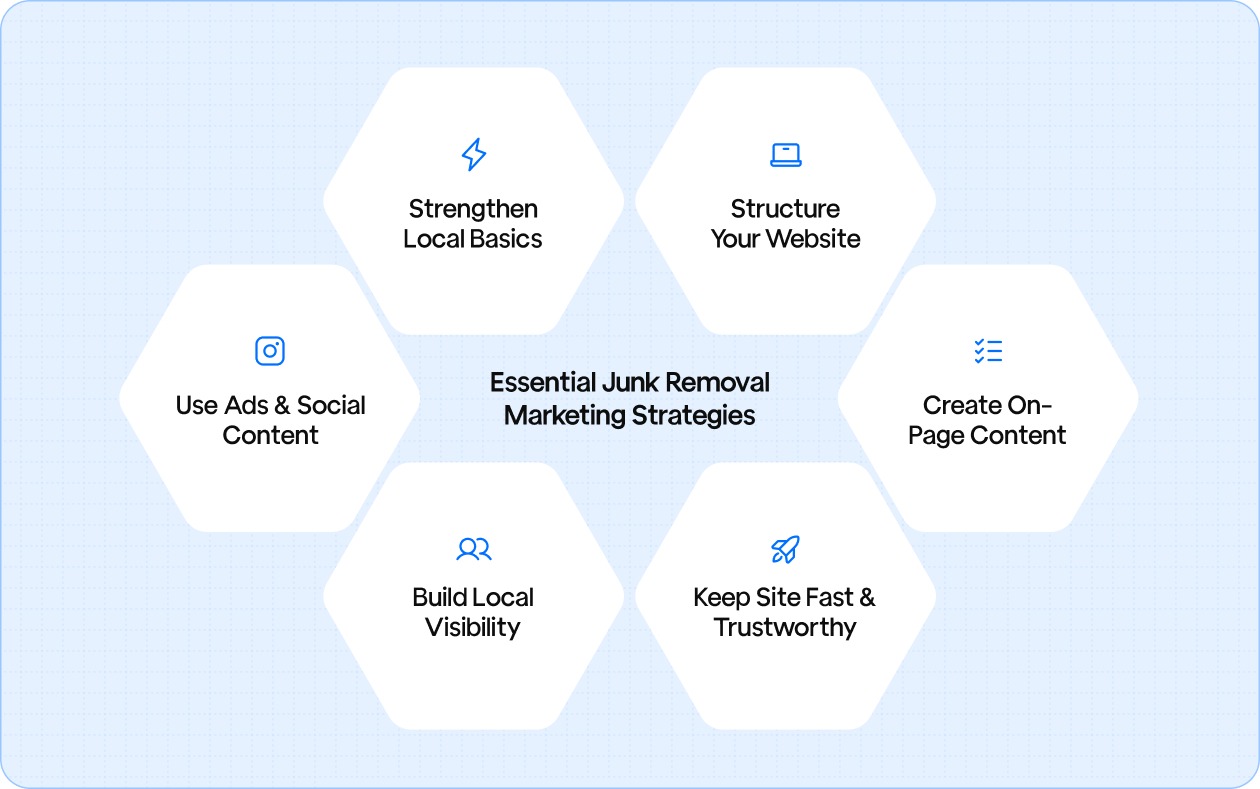
These strategies help your junk removal business get found, trusted, and chosen:
Local visibility is the heart of junk removal marketing. Most people look for the nearest reliable option and choose one of the first results they see. That makes your foundation the most important part of your marketing.
Here’s what this foundation includes:
Pro Tips:
A strong Google Business Profile brings in the easiest, highest-intent leads. We optimize your profile so locals see you first and choose you over competitors.
When someone visits your website, they want answers right away: what you do, where you work, and how to contact you. A clear structure guides them to these answers with no confusion.
The most helpful pieces include:
Service pages: Simple pages that explain each job type, such as furniture removal, garage cleanouts, appliance disposal, or construction debris.
Pro Tips:
One page per main service helps searchers find exactly what they need and call quickly.
Pro Tips:
Good on-page content is nothing more than clear language, helpful images, and simple explanations. It shows customers exactly what you do and helps Google understand your business.
Here’s what matters most:
Pro Tips:
Get your website ranking high on search engines and start attracting more local clients. Let’s optimize your online presence!
Your website is often a customer’s first impression of your business. If it feels unreliable, slow, or confusing, they move on to the next option.
A trustworthy junk removal website should:
These details build confidence and help you earn more calls.
Here are some tools you can use to track your page’s performance:
Search engines look at where your business is mentioned online. Mentions from trusted local places tell search engines that your business is active and legitimate in your community.
Ways these mentions appear include:
Paid ads and social content help you reach people at the moment they decide they need junk removal. These channels work well because customers often act immediately once they decide they want the clutter gone.
This includes:
Here are the most common issues that slow down growth and how to avoid them.
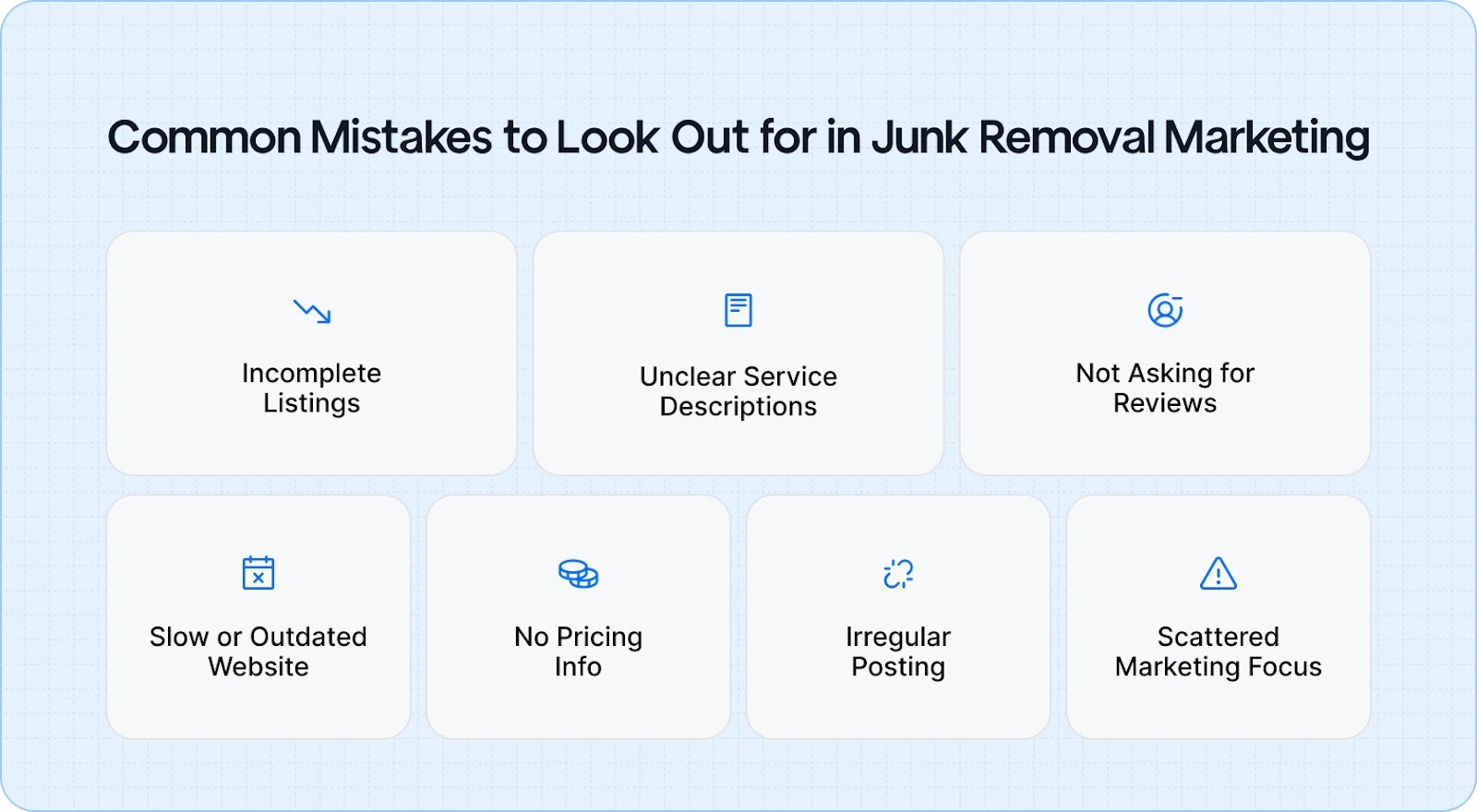
1. Missing or incomplete online listings: If your Google Business Profile or Apple Business Connect is half-filled or outdated, customers will skip you. Missing hours, no photos, or old phone numbers make your business look inactive.
2. Using unclear or confusing service descriptions: Calling yourself “full-service removal” isn’t enough. Customers need to see clear wording like “garage cleanouts,” “mattress removal,” or “appliance hauling.” Vague language makes people leave your page and pick someone else.
3. Forgetting to ask for reviews: Reviews are the biggest trust factor in this industry. If you finish jobs without asking for a review, you’re missing out on the easiest way to stand out and rank higher.
4. Having a slow or outdated website: If your site takes too long to load or doesn’t work well on phones, people won’t wait. A slow site suggests slow service, even if you’re great at the job.
5. No pricing cues anywhere: Customers hate guessing. When you don’t share starting prices or simple cost ranges, people assume you’re expensive or unreliable.
6. Posting only once in a while: Irregular posting makes your business look inactive. Weekly updates on Google, Apple, or social platforms keep you visible and relevant in your area.
7. Trying too many marketing tactics at once: Many junk removal owners jump from ads to flyers to SEO without giving anything time to work. Marketing gets easier when you focus on a few basics: GBP, a clear website, good photos, and reviews.
By understanding your audience, creating a strong online presence, gathering reviews, forming partnerships and tracking your results, you position your business for sustainable growth.
At Gushwork, we specialize in:
If you want clearer visibility, steady calls, and a setup that works even on slow weeks, we can build that foundation for you.

If you’ve been thinking about starting a junk removal business, the first question that usually comes up is simple: “How much does it actually cost to get started?”
And it’s a fair question, because the numbers you see online can range from a few hundred dollars to tens of thousands, depending on who you ask.
The truth is, you don’t need a huge budget or a brand-new truck to enter this industry. What you do need is a clear understanding of the real costs, the optional costs and the hidden costs that most beginners only discover the hard way.
In this blog, you’ll learn the complete cost breakdown for starting a junk removal business, the price differences between lean and full-setup launches and the most efficient ways to spend and save your money in your first few months.
A junk removal business is a service that helps people clear out unwanted items quickly and responsibly. This includes old furniture, appliances, yard waste, renovation debris, garage clutter, estate cleanouts and anything else a homeowner or business can’t move or dispose of on their own.
These companies handle the heavy lifting, sorting, hauling and proper disposal or recycling. For customers, it’s a simple solution to reclaim space without dealing with the physical work, transport or local disposal rules.
A junk removal business sells convenience, speed and relief, and that’s why it continues to grow as more people look for fast, stress-free cleanouts.
Starting a junk removal business might look simple, but without a plan, it quickly becomes chaotic and expensive.
Here’s why it matters:
Build an ICP and keyword plan that targets local homeowners, contractors and businesses searching for junk removal help.
Launching a junk removal business requires understanding every cost you’ll face before your first job. These expenses don’t just determine your initial investment, but they shape your pricing, profitability, and how fast you can grow.
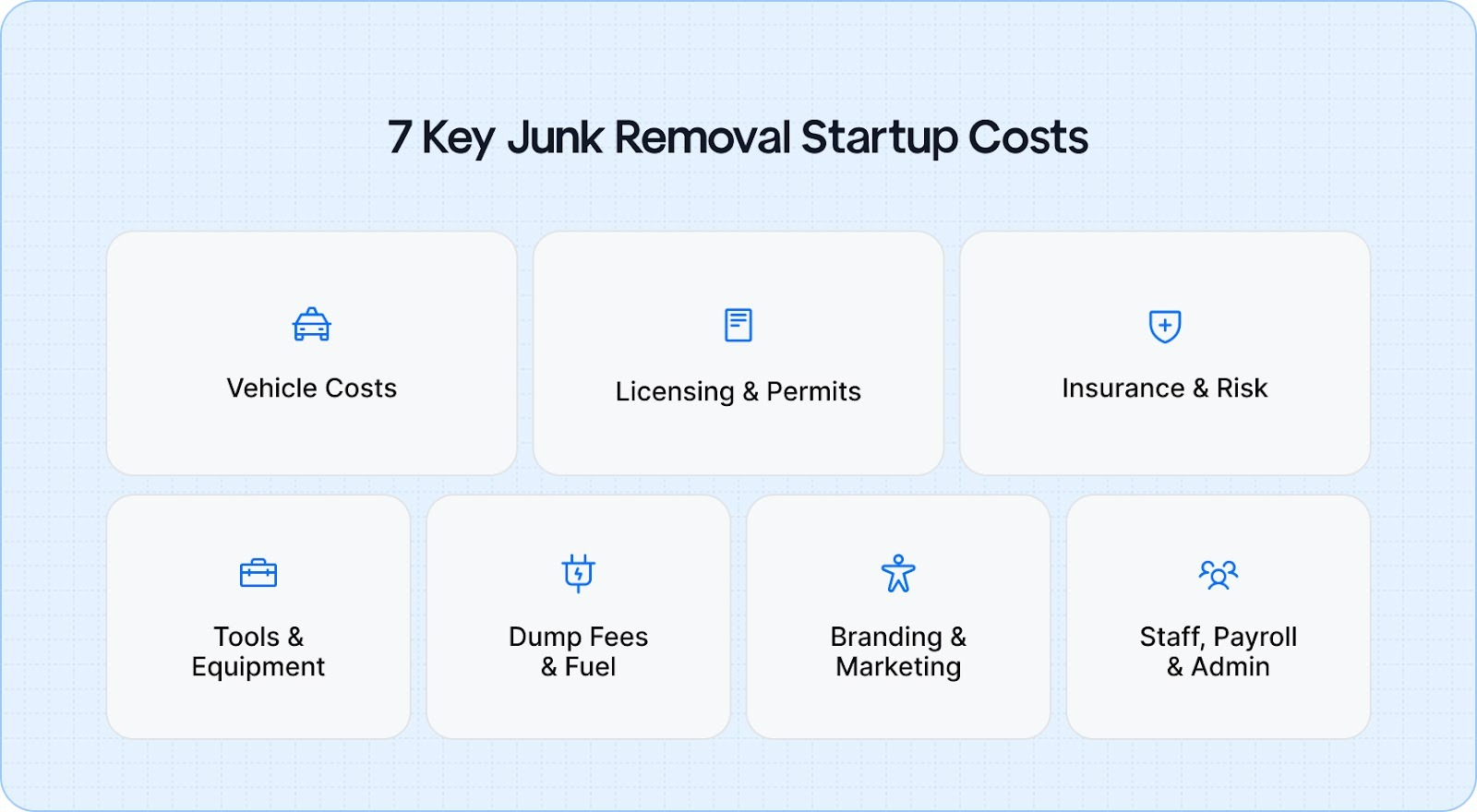
This section breaks down each core startup cost in simple, practical terms so you can budget confidently and avoid surprises:
Your vehicle is your office, billboard, and revenue engine.
What you might spend
Sources aimed at junk hauling show the truck/vehicle alone often sits around $20,000–$30,000 in a “typical” startup budget, before tools or branding.
What You Can Do:
You need to be legal and insurable from day one.
You Will Need:
One recent guide estimates permits and licences around $3,500 for a more formal setup, though many solo operators pay less if they keep it lean and local.
What You Can Do:
Junk removal touches people’s homes, driveways, and sometimes hazardous materials. One bad incident can wipe out your savings if you’re uninsured.
Common policies
Put combined liability + auto insurance in the $300–$800/year “starter” range for very lean setups, but expect to pay more as revenue, staff, or risk grows.
Points to Remember:
You don’t need a warehouse full of gear to start, but you do need enough to work safely and efficiently.
Core gear list:
For basic tools, you will need $600–$1,000, but for heavier equipments, it can go $6,000 plus, if you’re setting up more industrial or multi-service operations.
Budget range to plan:
Even in month one, you’ll pay to get rid of junk and keep your truck moving.
What To Expect:
Treat these as startup working capital, cash you keep in the bank so you can run jobs without stressing over every dump ticket.
A small, focused marketing budget up front can be the difference between a truck that sits and a truck that stays booked.
Key Requirements:
One detailed junk removal cost breakdown suggests $2,500 for initial marketing in a more fully built launch, while ultra-lean setups sometimes start with $50–$200 on basic promotion and scale as revenue comes in.
Create clear messaging, strong visuals and simple marketing that make your junk removal business stand out locally.
If you’re starting solo, this section might be small at first, but don’t ignore it if you plan to grow.
Startup Considerations:
Start lean, then build systems and people into your cost structure once revenue is predictable.
To make all of this less abstract, here are three simplified example scenarios. These aren’t quotes, just planning lenses to help you decide where you fit.
You already own a truck, work from home, and do most jobs yourself.
Estimated startup range: roughly $2,500–$6,000 cash needed to get moving.
Good fit if you want to test the market, keep your day job initially, or stay very local.
You’re committed to full-time, buying a decent used truck, and want to look established from day one.
Estimated startup range: Often $22,000–$40,000, depending on vehicle cost and how polished you go on branding.
Good fit if you want to compete seriously with the established players in your city.
You’re launching with staff, more than one vehicle, and dedicated yard/office space.
Estimated startup range: Easily $60,000–$150,000+, similar to some of the higher-end estimates you’ll see in industry guides that quote up to $300,000 for fully built-out multi-location operations.
This path is for operators with capital, experience, or backing, often aiming to own a whole region, not just a neighborhood.
When you think “startup cost,” it’s easy to only count what you spend before your first job. But some costs kick in fast and need to be baked into your planning:
The simplest safeguard: keep 1–3 months of operating expenses in reserve if you can. That cushion turns a broken alternator or slow month into an inconvenience, not a crisis.
You want to look professional without overspending. A few practical rules:
Starting a junk removal business doesn’t require franchise-level capital, but it does require clear eyes about the real costs. For your junk removal business startup cost will be shaped by the truck you choose, how polished you want to look on day one, and how fast you plan to grow.
Start with the numbers. Decide which launch level fits you. Then build a business that’s as solid and dependable as the service you plan to offer.
Get guidance on planning costs, choosing equipment and building a solid first-year strategy.

Industrial sales used to start with outreach. Today they start with research. Buyers don’t want pressure. They want clarity. They want proof. They want to feel confident in a partner long before they ever schedule a call.
This means the companies winning the best industrial sales leads are more helpful, more visible and more consistent. They show buyers what they know, how they work, and why their solutions matter.
Strong industrial leads are the result of intentional communication that meets buyers where they already are: learning, evaluating, and deciding. And your business can guide every step of that journey.
Lead generation in the industrial world involves identifying companies that genuinely need a new supplier or have an upcoming project. These buyers move slower than consumers and usually involve several people in the decision. They care about your capabilities, certifications, tolerances, and whether you can support them long term.
In this space, a lead is a buyer with a real technical need, a timeline, and the authority to move a project forward. Effective lead generation helps these buyers discover your capabilities early, understand what you can handle, and trust you enough to start a conversation or issue.
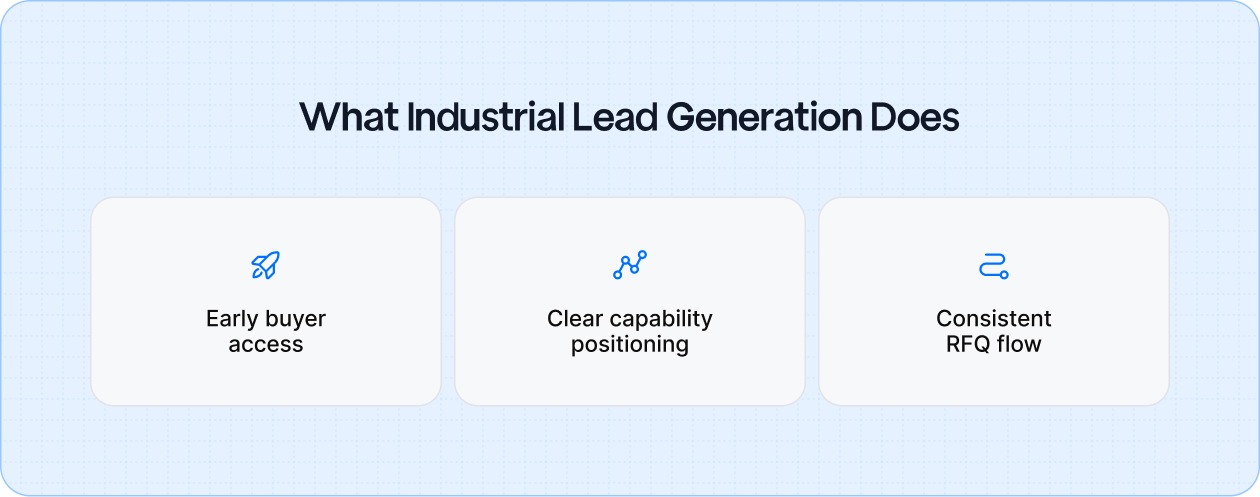
Industrial lead generation does three things for you:
Build an ICP and keyword plan that aligns with the capabilities, applications and industries you serve best.
Below are the methods that consistently attract the right kind of leads, the ones with defined needs and a high chance of becoming repeat customers.
Most industrial companies already have a product catalog or capabilities brochure. The problem is that it often sits as a static PDF, buried three clicks deep on the website.
To make your catalog generate leads:
When your catalog is easy to search and tied to RFQ or enquiry forms, it becomes a continuous source of qualified industrial sales leads, not just a reference document.
Industrial buyers and engineers spend a lot of time researching before they ever speak to sales. Your website should help them do that work.
Useful content that supports lead generation:
The more your website answers real technical questions, the more often you’ll earn contact from serious buyers.
Want a quick health check on your website? Drop it into our AI Analyzer and get instant insights to help turn more visitors into paying customers.
Video remains underused in manufacturing, yet engineers and buyers watch videos to understand processes, compare suppliers, and validate capabilities.
What to create:
Video builds trust faster than text. Seeing your machines, people, and process reduces perceived risk, especially for buyers sourcing a new supplier.
A generic “Contact us” form attracts everything from students to one-off prototype requests. Quotation forms and project enquiry forms let you qualify leads earlier.
To make forms work for you:
A focused prospect form helps your team decide which leads to call first and which to park or decline politely.
Industrial buyers rarely start on social media. They start on channels built for engineering and sourcing. Your job is to show up there with clear, technical information.
Places to consider:
If you invest time or budget in these channels, make sure your listings:
Treat each platform as a feeder into your own website and sales process, not as a disconnected listing.
GBP is one of the most overlooked sources of high-intent industrial sales leads, especially for regional manufacturers, fabrication shops, job shops, and machining companies.
What to do:
A strong GBP helps you appear when local engineers and buyers search things like “metal fabrication near me”, “precision machining supplier”, or “custom PCB assembly shop”.
Optimise your Google Business Profile so engineers and buyers see your capabilities, photos and contact details clearly.
Email still works in manufacturing, as long as it respects the receiver’s time and context.
Two main use cases:
To keep email effective:
Email becomes a lead generation tool when each message connects a real problem to a specific capability you can offer.
In manufacturing, a single account can represent years of revenue. That makes account-based thinking more practical than chasing random leads.
To align around key accounts:
The goal is not just more names in the database, but deeper engagement inside the companies that matter most to your growth.
Trade shows and webinars are expensive if they only deliver business cards. They are valuable if they feed into a structured follow-up process.
To make events generate industrial sales leads:
Think of events as concentrated lead generation moments. The real value is harvested in the weeks after, not only during the trade show marketing.
If you sell through distributors, reps, or integrators, they are also a source of industrial sales leads. But they need more than a logo and a price list.
Give partners tools that directly support lead generation:
When partners are equipped to explain where you fit best, you receive cleaner, better-qualified opportunities instead of mismatched requests.
Industrial purchasing rarely depends on one person. Engineers, procurement, quality, and operations all influence decisions. A multi-channel approach ensures your brand shows up at different stages of their process, even when they’re researching quietly.
How to use it effectively:
Multi-channel doesn’t mean “be everywhere.” It means showing up where your specific buyers already look for suppliers.
Strengthen your SEO so buyers searching by process, material or tolerance can find you when it matters.
Without measurement, it’s easy to over-invest in channels that generate “activity” rather than revenue.
At a basic level, track:
You don’t need a complex dashboard to start; a simple monthly review with sales is enough to see what is bringing in leads worth quoting and what is not.
Not every enquiry deserves the same amount of time. Clear qualification criteria help your team focus on leads that can become profitable, repeat business.
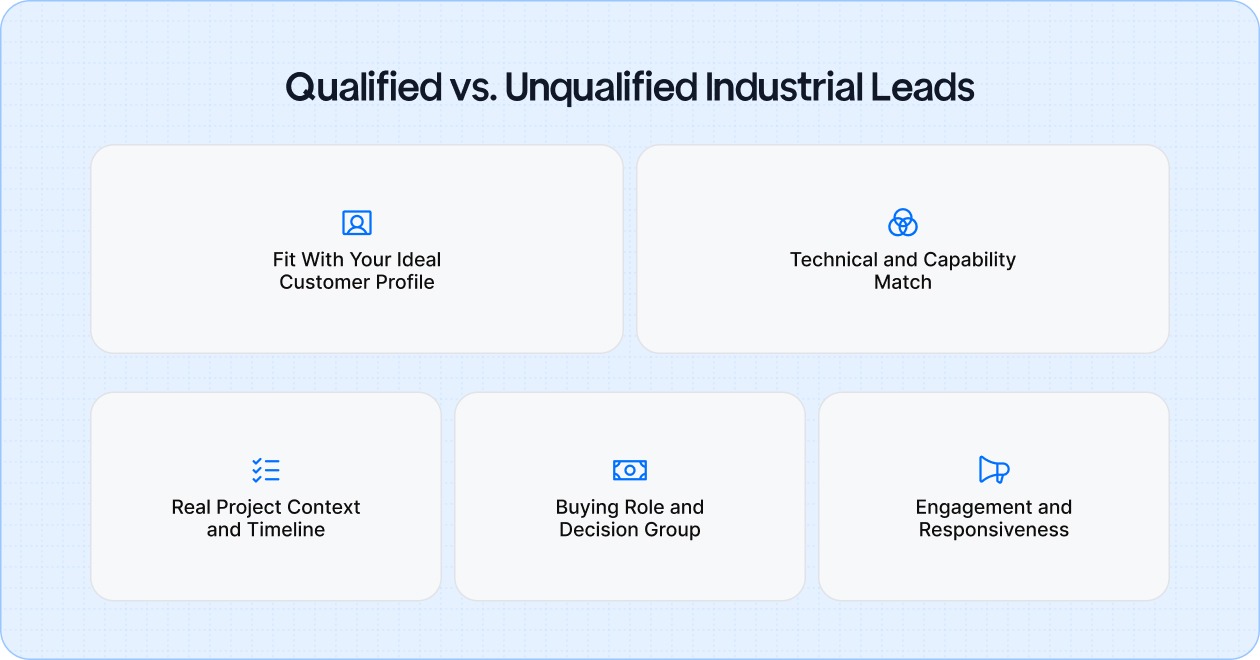
A qualified lead usually:
Non-qualified leads often sit outside your target sectors or require project sizes that are too small (or occasionally too large) for you to serve well.
Check whether:
If a lead needs something you have never done, or that would disrupt your core production, it may be better to decline or refer.
Qualified industrial sales leads usually come with a clear context:
Red flags include vague timing (“sometime next year”), no clear use case, or a request that appears purely exploratory with no identified project behind it.
In B2B manufacturing, the person who contacts you may be:
All can be valuable, but a qualified lead usually has visibility into the broader decision group or is willing to involve others. If a contact cannot explain who approves suppliers, who signs off on specs, or how sourcing decisions are made, treat it as early-stage until that clarity is gained.
Lead quality also shows up in behaviour:
If a prospect goes silent for weeks, refuses to share basic information, or only asks for “your best price” without dialogue, they may be more interested in price shopping than true partnership.
To make this practical, you can build a short checklist for every new lead:
If most answers are “yes,” you have a qualified industrial sales lead. If several are “no” or unclear, treat it as lower priority or nurture until it matures.
The companies that grow steadily are the ones that make it easy for the right buyers to understand what they do, see proof that it works, and start a focused conversation.
If you turn your catalog into a working asset, build flows that filter instead of flood, show up in the channels your buyers already use, and agree internally on what “qualified” really means, lead generation stops being guesswork. It becomes another well-run process in your operation, measured, improvable, and tied directly to the kind of business you want more of.
Get guidance on building a lead system that attracts the right projects and filters early.

In the roofing business, the real work begins when you make sure people in your community know who you are and why they should choose you when their roof needs repair or replacement.
With storm damage, leaks, worn-out shingles, seasonal maintenance, and those unexpected roofing emergencies, homeowners are constantly searching for a reliable, trustworthy roofer.
But with so many options out there, how do you stand out? Let’s dive into 56 roofing marketing ideas that will help you connect with more clients, build your reputation, and grow your business in 2026.
A strong online presence is the foundation of any successful roofing business. With an optimized website, effective SEO strategies, and active business listings, you can increase visibility, attract the right customers, and build trust.
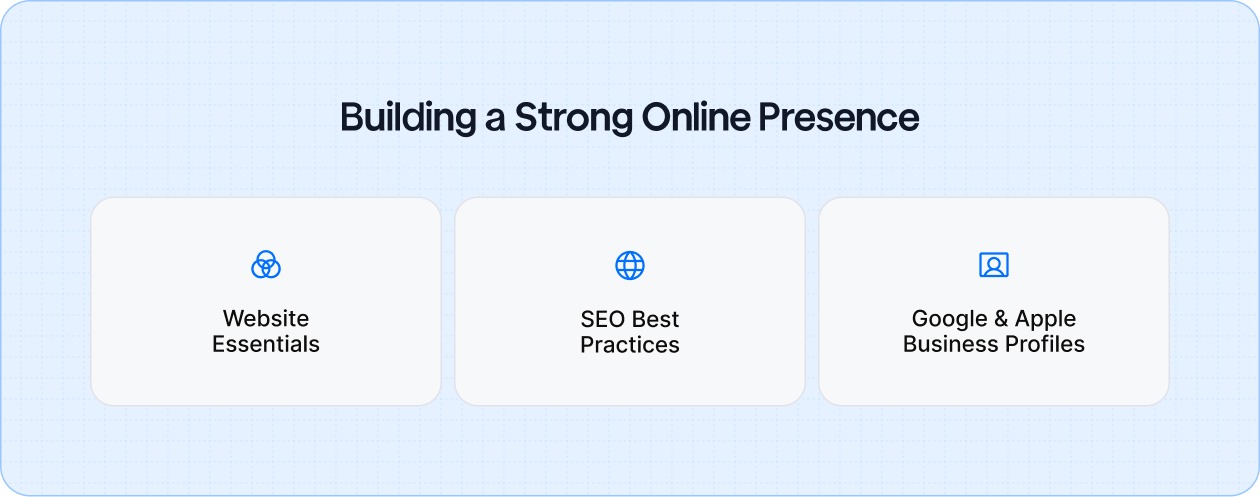
Here's how to create a website that attracts attention and converts visitors into loyal clients.
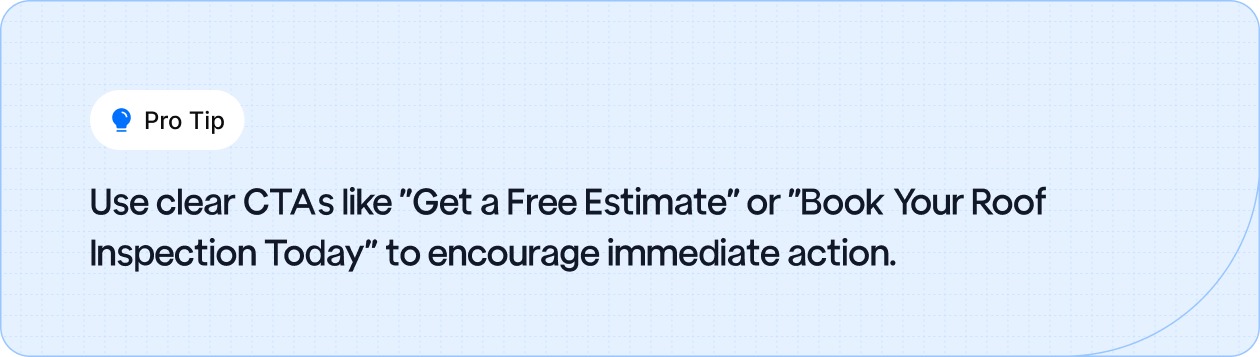
Your online content decides whether people call you or scroll past; the right help can make your business easier to find when someone needs a roofer.
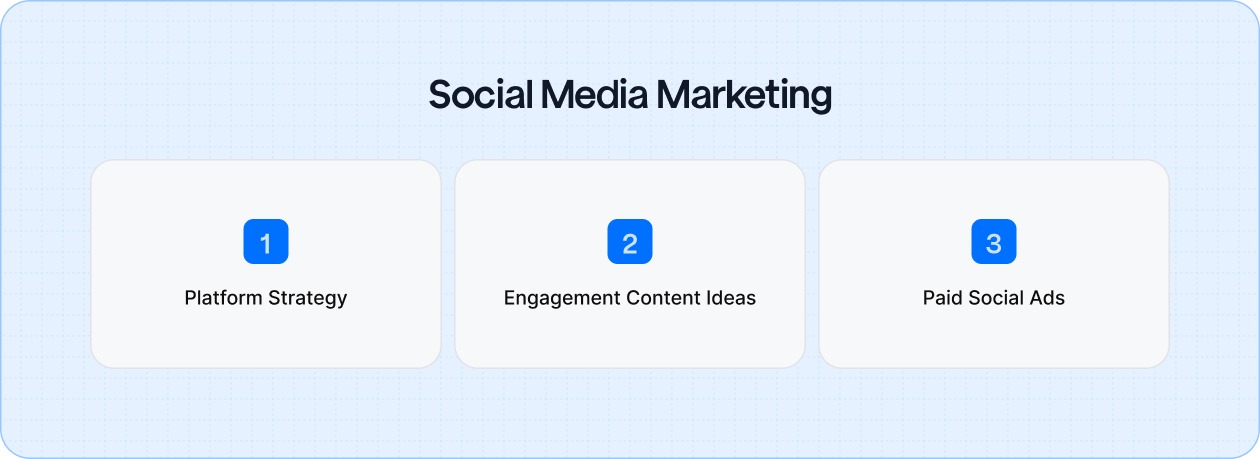
By creating engaging content personalized to different platforms and incorporating paid ads, you can increase your reach and show your community that you're the go-to expert for their roofing needs.
Here’s how to take your social media strategy to the next level and create a consistent, valuable presence online.
Referral marketing is one of the most effective ways to grow your roofing business, turning satisfied customers into your best salespeople. By creating easy-to-use referral programs, partnering with local vendors, and tapping into third-party platforms, you can increase leads and expand your customer base without spending a fortune on advertising.
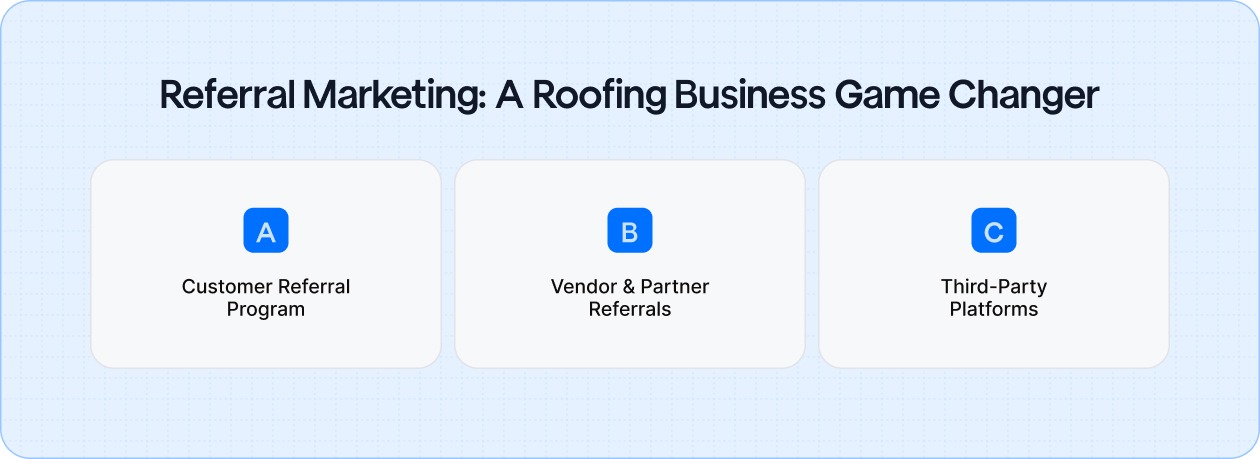
Here’s how to turn word-of-mouth into a powerful growth tool for your business.
Word of mouth and community engagement is one of the most authentic ways to generate new business. By tapping into local networks, sponsoring events, and offering personalized services, you can build strong connections and establish yourself as a trusted roofer in your community.
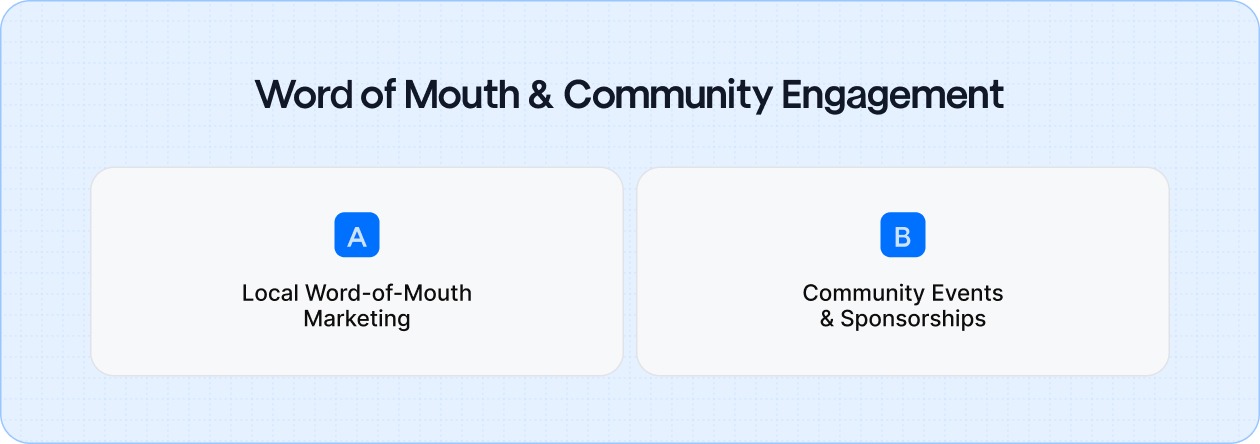
Here’s how to make the most of local marketing and community involvement to enhance your business.
Email marketing is a powerful tool for staying connected with your customers and keeping them engaged throughout their roofing journey.
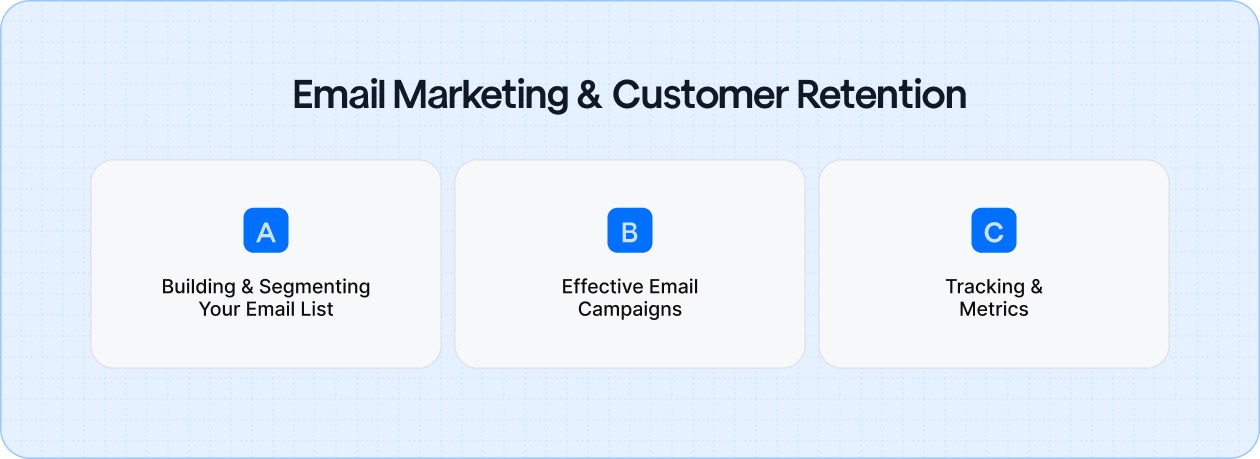
Here’s how to effectively incorporate email to retain customers and improve your marketing efforts.
Paid advertising and retargeting strategies are essential for reaching the right customers at the right time.
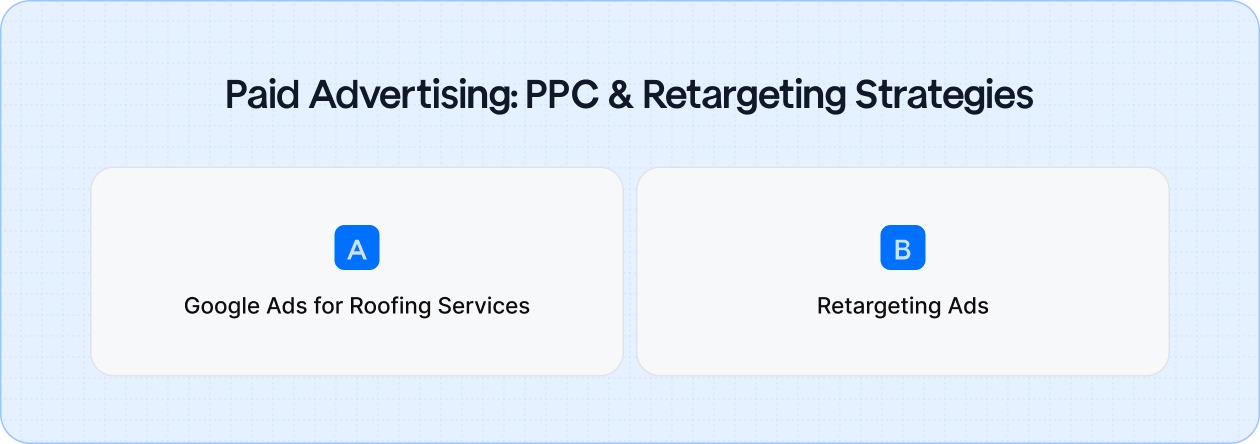
Here’s how to optimize your PPC and retargeting campaigns for the best results.
Seasonal promotions and timely content can set your roofing business apart during key times of the year. By targeting specific needs like storm damage or seasonal maintenance, you position yourself as the trusted expert when customers need you most.
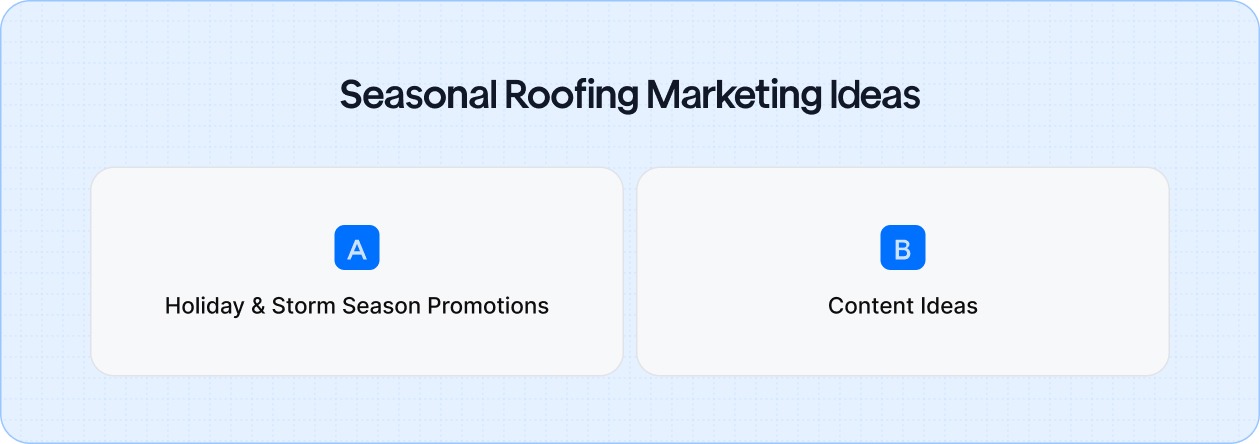
Here’s how to capitalize on these opportunities and keep your business top-of-mind all year round.
Must Read: Stop Running After Leads, Start Attracting Them: 10 Easy Roofing Tips
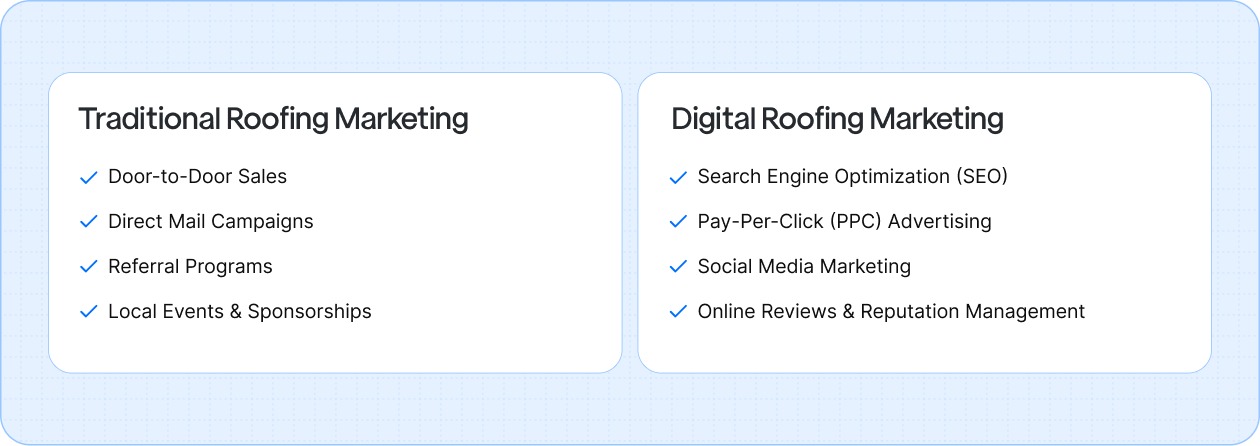
Traditional and digital marketing each offer unique ways to connect with potential customers and grow your roofing business. Here’s how you can use both strategies effectively in 2026.
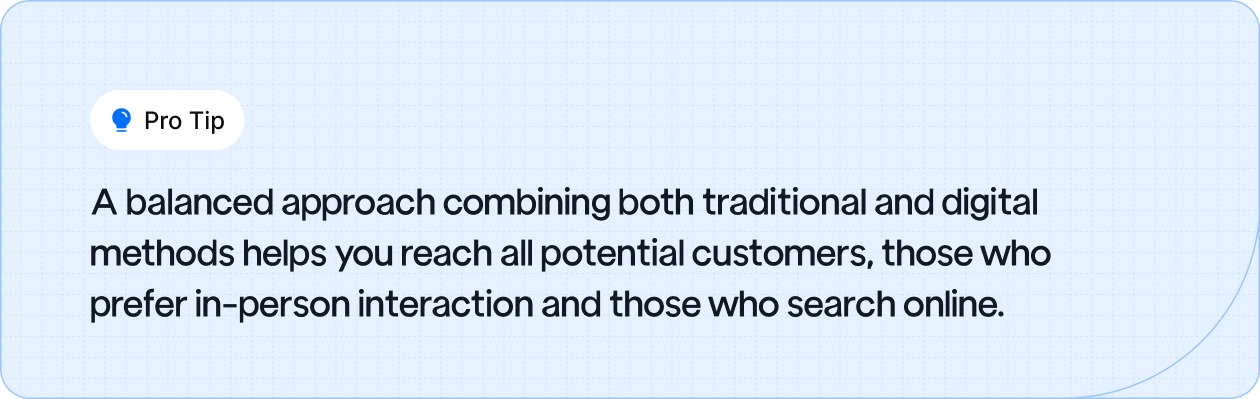
AI is revolutionizing roofing marketing by automating tasks like content generation and SEO optimization, allowing you to target the right audience more effectively. With tools like lead scoring and predictive analytics, you can make smarter, data-driven decisions that maximize your ROI and streamline your efforts.
With the 56 roofing marketing ideas shared in this guide, you now have the tools to enhance visibility, generate leads, and build long-term relationships. Gushwork’s AI-powered SEO and content solutions simplify your marketing, so you can focus on growing your business.
Gushwork helps roofing companies stand out with SEO-backed content that explains value clearly, attracts the right enquiries, and builds trust with homeowners.

Some contractors think they have a marketing problem. Most actually have a visibility problem. People in your city are already searching for someone who does exactly what you do, at the exact moment you’re reading this. The real issue is simple. They’re finding someone else first.
Lead generation in 2026 is about showing up clearer, faster, and more credibly than the next contractor.
In this blog, you’ll learn the strategies that help contractors get chosen first, why old tactics fail, and how to build a lead flow you can rely on week after week.
Contractors today face a very different market than they did even five years ago.
The basics haven’t changed: people want someone they trust, at a fair price, who will show up and do the job properly. What has changed is how they decide that.
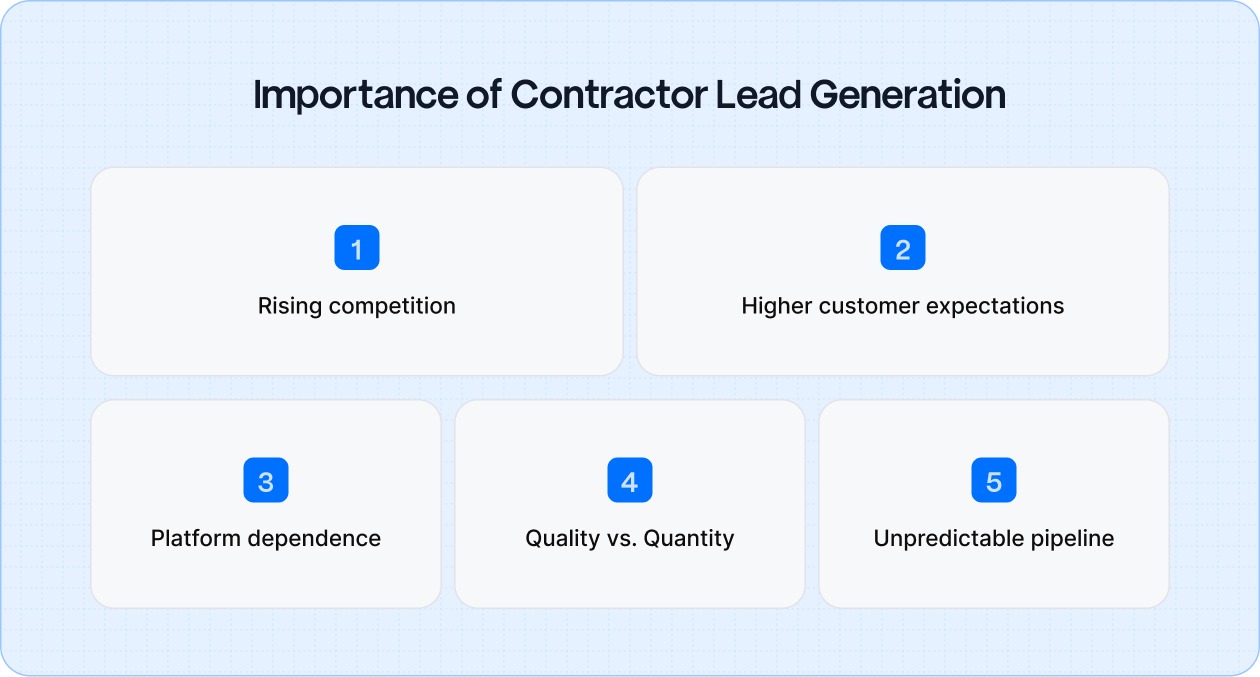
Here are the biggest challenges contractors face:
Effective lead generation solves these challenges by helping the right customers find you, trust you, and choose you, before they ever speak to another contractor.
There are hundreds of tools and lead vendors out there, but only a handful consistently help contractors turn marketing spend into booked work.
Below is a practical rundown of the best contractor SEO services for lead generation right now, what they’re good at, and when they make sense in your mix:
Gushwork is a hands-on marketing partner for contractors and industrial companies that want a proper pipeline. The focus is on building a system: website, SEO, PPC, GBP, tracking, and reporting that fits how you actually sell jobs.
Why Gushwork is the Top Choice?
How it helps with contractor lead generation:
Strengthen your website and service pages so search engines understand what you do and who you serve.
Scorpion is a large marketing platform that focuses heavily on home services contractors (roofing, HVAC, plumbing, law, etc.). They offer websites, SEO, paid ads, chat, and basic CRM tools under one roof.
What Scorpion offers
Scorpion’s strength is scale and packaged solutions. That can be helpful if you want “most of it handled” quickly, but it may feel less flexible for contractors who want more tailored strategies or smaller, experimental campaigns.
Blue Corona works mainly with home service companies (HVAC, plumbing, electrical, remodeling), with a strong emphasis on tracking and analytics.
What Blue Corona offers
They tend to work best with contractors ready to invest consistently in marketing and who care about detailed reports and long-term compounding gains.
WebFX is a large digital marketing agency that serves many industries, including contractors and home services. They’re known for a wide service menu and strong technical SEO capabilities.
What WebFX offers
WebFX is a good option if you want a broad digital program (SEO + content + paid) and you’re comfortable working with a larger, systematised agency rather than a niche trade-only shop.
Contractor Dynamics focuses heavily on roofing and some exterior trades. They combine training, coaching, and done-with-you marketing to help instead of acting as a pure “done-for-you” agency.
What Contractor Dynamics offers
This is a good fit if you want to build internal marketing muscle and keep more control, rather than fully outsourcing all lead generation.
RYNO works mainly with HVAC, plumbing, and related home services. They position themselves as a performance-oriented agency that understands seasonality, call volume swings, and service-area constraints.
What RYNO offers
RYNO tends to work with contractors who already have some scale and are ready to push harder on growth with performance expectations.
There are also mid-sized agencies like Thrive and other regional firms that focus on contractors in specific geographies or niches.
What these agencies offer
Quality and fit can vary a lot at this tier. It’s worth asking for examples in your trade and region, plus clear reporting on cost per lead and booked jobs before you commit.
Here’s a simple, modern playbook that works across roofing, remodeling, plumbing, HVAC, electrical, landscaping, and other local trades:
Local listing sites (HomeAdvisor, Yelp, Angi, Thumbtack, Nextdoor, Houzz) still play a role because homeowners use them as discovery platforms. Being present gives you additional visibility beyond Google.
How to do it:
Your GBP is your single most important digital asset. It influences map-pack rankings, call volume, and local trust.
How to optimise it:
Optimise your Google Business Profile so local customers see clear services, real photos, and fast ways to contact you.
LSAs place you at the very top of Google for high-intent searches (“contractor near me,” “roof repair,” “kitchen remodel”). You pay per lead, not per click, making it one of the most reliable contractor lead channels.
How to get the most from LSAs:
Google Ads still generate some of the best contractor leads, if you avoid wasted clicks.
What works:
Contractors win big when happy customers do the selling. A good referral program turns past jobs into future revenue.
How to set it up:
AI-enhanced systems help contractors respond faster and keep conversations alive even when you’re on a jobsite.
What to use:
Homeowners trust the contractor who educates instead of hard-sells. Lead magnets work because they filter serious buyers from browsers.
Ideas that convert:
Create clear service pages, project snapshots and simple guides that help customers choose you faster.
Offline presence still matters in trades. People trust contractors they see in familiar spaces.
What to do:
Direct mail is still powerful for contractors who work geographically. It’s tangible, hyper-local, and pairs well with digital follow-up.
Best use cases:
Homeowners search for cost clarity before anything else.
Pages like “Cost to Install a New Deck in [City]” or “Bathroom Remodel Cost Breakdown for 2025” consistently attract high-intent visitors who are actively budgeting.
Most contractors avoid these pages, which is why they work so well.
Homeowners often collect multiple bids and get overwhelmed.
Create a simple offer: “Upload your existing quote, we’ll review it for free to make sure it’s fair.”
This positions you as a trusted expert, which frequently leads to winning the project.
Not long PDFs — simple 150-word snapshots:
These build enormous trust and give homeowners a real sense of what you can deliver. Post them on your website, GBP, and social media.
Contractors lose tons of business simply by missing calls while on the job.
A missed-call text system replies automatically: “Hey, this is John — sorry I missed your call. How can I help?”
This saves dozens of leads per month, especially during peak season.
Choose a single job each week and create:
Use it across email, GBP, and social to stay memorable.
Homeowners often search a competitor’s name when they’re close to making a decision. Bidding on those terms gives you a chance to appear beside that competitor without being negative or misleading. The goal is simple: offer clarity, not confrontation.
Instead of trying to “steal” customers, position your ad as a helpful checkpoint before they commit.
Why this angle works: It meets homeowners at a natural point in their research, when they want reassurance they’re making the right choice. You’re not undermining the competitor. You’re giving the homeowner a reason to double-check, which often turns into a conversation you wouldn’t have gotten otherwise.
Finding the right contractor lead generation service can feel overwhelming, especially when every platform promises “high-quality leads” and “instant results.” But not all lead providers understand how projects actually move: slow bids, long approval chains, multiple stakeholders, and high job costs.
Use the checklist below to evaluate any lead generation company before signing up:
1. Lead Quality: Do they filter by project type, budget, location, and timeline? Are leads exclusive?
2. Exclusivity & Territory Protection: How many contractors receive the same lead? Do they cap competition in your area?
3. Industry Specialization: Do they understand your trade and match you with the right job categories?
4. Transparent Lead Sources: Are leads from SEO, PPC, LSAs, or resold third-party lists?
5. Lead Verification: Do they validate phone numbers, emails, locations, and readiness?
6. Cost Structure & ROI: Is pricing per lead, per month, or per booked job? Is ROI easy to measure?
7. CRM Integration: Do they plug into Jobber, ServiceTitan, HubSpot, or your follow-up systems?
8. Support & Dispute Handling: Do they credit bad leads quickly and respond to issues fast?
9. Reputation & Proof: Are there real contractor reviews and case studies showing revenue outcomes?
10. Scalability: Can you add zip codes, pause volume, or expand as your crews grow?
11. Data Ownership: Do you own the customer list, and can you export it anytime?
12. Job-Type Alignment: Do they send leads that fit your capabilities, crew size, and service offerings?
Build local signals that help you rank in the neighbourhoods where your best jobs come from.
Your next step is simple: put one strong system in place at a time. Every improvement, better visibility, stronger messaging, faster responses, brings you closer to a business that runs on consistency rather than chance.
If you’re ready to turn “hope the phone rings” into a genuine growth engine, now is the time to act. Let’s build a lead generation system that supports your business every single day.
Get expert guidance on creating a clear, consistent pipeline for your contracting business.

If you run a laser cutting business, you know how crucial all the small details are. One wrong measurement, one slightly incorrect setting, and the whole project is ruined.
So why is it that so many laser cutting shops still use a super simple "Name, Email, Tell Us Everything" form? When a potential customer visits your site, they want a quote for a specific job, they know their material, their thickness, and they have a file.
If your form doesn’t ask for the right requirements up front, strong prospects slip away and your team loses time sorting through incomplete or unusable submissions.
In this blog, we’re going to talk about how to fix that. We'll show you how to build a smart, simple lead form that asks the right questions in the right way.
A laser cutting lead generation form is the page or pop-up on your website where potential customers submit project details so you can quote or follow up. It’s usually the bridge between “I’m browsing” and “I’m ready to talk about a part or project.”
For a laser cutting or fabrication shop, this form serves as a part intake form, a sales filter, and a quoting shortcut.
Upgrade your lead form and start receiving production-ready RFQs.
A high-performing laser cutting lead generation form filters, qualifies, and accelerates quoting. Optimize the experience, and your form becomes a revenue engine instead of a basic contact page.
Many buyers abandon forms because they’re overwhelmed at the first step. Instead of showing every question at once, use conditional logic to reveal details gradually.
How to execute this:
This keeps serious engineers engaged and prevents casual requesters from quitting early.
Leaving fields fully open-ended leads to vague submissions like “metal, 3-ish mm?” or “steel plate.” Structured dropdowns improve accuracy and speed.
How to execute this:
This minimizes clarification emails and supports faster quoting.
If your upload tool is clunky, slow, or rejects standard part files, you’ll lose high-value leads instantly.
Best practices:
Add a clear line: “Don’t have CAD files? Upload photos or sketches and we’ll help evaluate options.” This keeps hobbyists and prototype customers from bouncing.
Not every form submission deserves the same response time. A few smart questions help your team rank leads.
Examples:
These inputs improve workload planning and help route enterprise accounts to sales instead of general support.
Short explanatory text near fields increases completions and decreases confusion.
Helpful microcopy examples:
Small explanations reduce anxiety and increase trust.
Engineers and purchasing teams often browse supplier options on their phones, even if they upload files later from desktop.
Checklist:
If your form relies on desktop-only interaction, you’re losing leads daily.
People hesitate to share information when they aren’t sure who’s on the other end.
What to include nearby:
Trust signals reduce bounce rate and improve submission rate.
You can’t improve what you don’t measure. Reviewing how visitors interact with your form reveals exactly where friction occurs.
What to monitor:
Tools like Hotjar, Microsoft Clarity, and GA4 form events make this painless.
The experience shouldn’t end at “Thank you.”
Send an automated email that includes:
It prevents follow-up emails like “Did you get my files?” and reassures serious buyers.
Forms degrade over time due to browser updates, plugin failures, and changing customer needs.
Quarterly checks should include:
A broken form can silently destroy your pipeline for weeks if unnoticed.
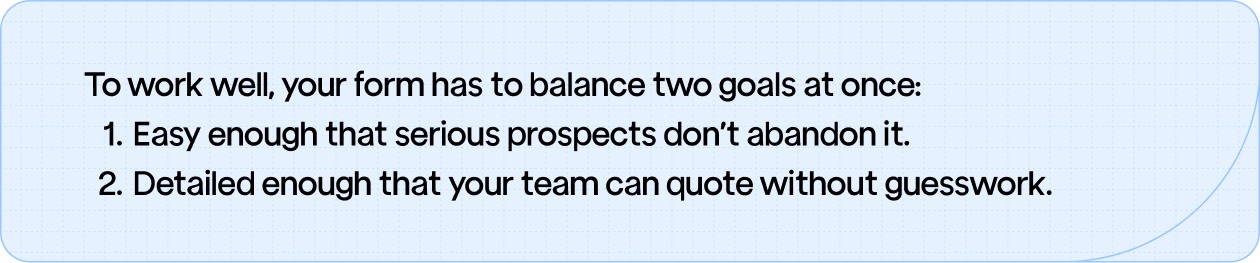
Here are the key building blocks.
A strong lead form gives you just enough information to respond quickly and understand what the prospect is trying to get done. These fields keep the form simple, reduce drop-offs, and still give you what you need to qualify the job from the first touch.
What to include:
These essentials make the form fast to complete while giving you the core information needed to reply confidently and assess whether the project is a good fit.
Once the essentials are covered, advanced fields can give you deeper technical insight without overwhelming the user. These details help your team quote accurately, avoid feasibility issues, and understand the real scope of the job before a single email is exchanged.
High-value advanced fields to include:
These advanced fields give you a more complete picture of engineering expectations before quoting begins.
A smarter lead form pays for itself. When you ask for the right details upfront, material, specs, and design files, you cut out the confusion and stop wasting hours on dead-end inquiries. Put these simple changes in place, and suddenly high-quality laser cutting leads feel less like a chase and more like a steady flow of real opportunities.
If you want better leads, build a better form.



.svg)
.svg)
.png)
.svg)

.svg)
.svg)
.svg)
.svg)
.svg)
.svg)
.svg)
Get started with your organic growth journey!

